
Ingredients
Milk and culture
- 9 litreswhole cow milk, fresh and not ultra-pasteurised
- ¼ tspmesophilic starter culture, or 200 ml cultured buttermilk
- ½ tspvegetarian (microbial) rennet, diluted in 60 ml cool unchlorinated water
- 1 tspcalcium chloride diluted in 60 ml water, if the milk is pasteurised
Stretching and salting
- 4 litreswater, heated to 75–80°C (165–175°F)
- 3 litrescool water and 300 g salt, for the brine
- 1long-bladed knife, a thermometer and a large heatproof bowl
Directions
- Warm the milk gently to 32°C (90°F) in a large pot, stirring so it heats evenly. Add the calcium chloride if using, then the starter, and let it ripen for 45 minutes with the lid on, holding the temperature.
- Stir in the diluted rennet with 20 up-and-down strokes, still the milk, and leave it undisturbed for 45 minutes until it sets to a firm curd that gives a clean break when you lift it with a knife and the whey runs clear yellow-green.
- Cut the curd into 1.5 cm cubes and rest 5 minutes, then stir gently and raise the temperature to 38°C (100°F) over 30 minutes. The cubes shrink and firm up.
- Let the curd settle, drain off the whey, and leave the curd mass in the warm pot, covered, to acidify. This is the long, unhurried part: 3 to 4 hours, turning the slab every 30 minutes.
- Test for stretch from about hour three. Drop a walnut-sized piece into water at 75°C (165°F) for a minute and pull it. When it stretches into a long, glossy, unbroken rope rather than tearing, the curd is at the right acidity, roughly pH 5.2. Too early and it shreds; too late and it goes brittle and soapy.
- Slice the curd into finger-width strips and put a batch into the hot water. Work it with a wooden spoon and then with gloved hands, folding and pulling until it comes together into one smooth, shiny mass.
- Now stretch it. Pull the mass out into a long ribbon about 3 cm wide, doubling and re-stretching several times so the protein aligns into fibres. That alignment is what makes quesillo peel apart in strings.
- Drop the finished ribbon into the cool brine for 15–20 minutes to season and firm, then lift it out.
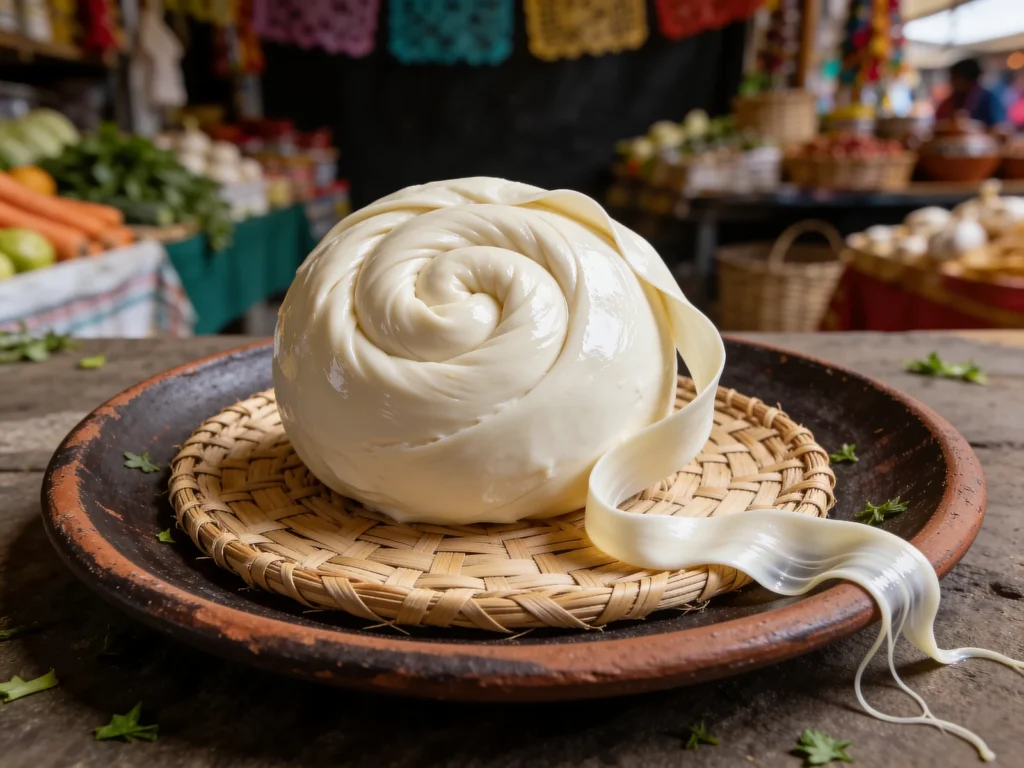
- Wind the still-warm ribbon around itself into a tight ball, the way wool is wound, tucking the end under. A 900 g ball is a small one by Oaxacan standards.
- Rest the ball in the fridge for a few hours before eating. Use within a week; quesillo is a fresh cheese and does not improve with age.
- To use, peel it apart into strings by hand rather than grating: it melts into quesadillas, tlayudas and choriqueso, and is eaten raw on a botana plate.
Technique
- Quesillo is a pasta filata cheese, sharing its technique with mozzarella and provolone, and by local account was invented in Reyes Etla, Oaxaca, in the 1880s when a girl left the curd too long and stretched it to save it.
- Everything turns on acidity, not on time. Use a pH meter if you have one and aim for 5.1–5.3; otherwise rely on the stretch test, which is what village cheesemakers do.
- Traditional quesillo is made with raw milk and animal rennet. Microbial rennet is specified here so the cheese is suitable for vegetarians and is now widely used commercially; if you do use raw milk, the cheese should be aged or the milk from a herd you trust, since fresh raw-milk cheese carries real listeria and salmonella risk.
- Do not let the stretching water boil. Above 85°C (185°F) the fat renders out, the curd goes greasy and stringy in the wrong way, and the finished ball weeps.
Substitutions
- No mesophilic culture: 200 ml of live cultured buttermilk ripens the milk perfectly well, though the timing is less predictable.
- No microbial rennet: traditional animal rennet works identically but makes the cheese unsuitable for vegetarians.
- In a recipe calling for quesillo, low-moisture mozzarella is the closest substitute, though it is blander and less salty.
Variations
- Quesillo is sold in balls from 100 g to several kilos, and Oaxacan markets sell it by the wound ribbon.
- Queso asadero from Chihuahua is made by a similar stretching method but pressed into flat cakes rather than wound.
- Some Oaxacan makers work chopped epazote or chile into the ribbon as they wind it.
History
Oaxacan accounts trace quesillo to Reyes Etla in the 1880s, where overheated curd was stretched into ribbons using a pasta filata technique.
Frequently asked questions
What is Queso Oaxaca?
Queso Oaxaca is a cheese & dairy from Mexico: mild white cheese wound into a ball of ribbons, melted into quesadillas. Oaxacan accounts trace quesillo to Reyes Etla in the 1880s, where overheated curd was stretched into ribbons using a pasta filata technique.
How long does Queso Oaxaca take to make?
Queso Oaxaca takes 1 hr of preparation and 4–5 hr, mostly waiting of cooking. The recipe makes about 900 g of cheese. It is rated hard to make.
What can I substitute in Queso Oaxaca?
Yes, within limits. No mesophilic culture: 200 ml of live cultured buttermilk ripens the milk perfectly well, though the timing is less predictable. No microbial rennet: traditional animal rennet works identically but makes the cheese unsuitable for vegetarians. In a recipe calling for quesillo, low-moisture mozzarella is the closest substitute, though it is blander and less salty.
What is the most important thing to get right in Queso Oaxaca?
Test for stretch from about hour three. Drop a walnut-sized piece into water at 75°C (165°F) for a minute and pull it. When it stretches into a long, glossy, unbroken rope rather than tearing, the curd is at the right acidity, roughly pH 5.2. Too early and it shreds; too late and it goes brittle and soapy.