
Ingredients
The maize
- 1 kgwhite maize
- whole dry grain
- sound, unbroken, not mouldy
- see the note on mycotoxins
- water, for soaking
The starter
- 2 tablespoonsmawè from a previous batch
- if you have it
- see the note on back-slopping
- or none, for a first batch
Equipment
- a large bowl
- a mill, or a food processor
- or a grain mill at a shop
- a sieve
- a clean cloth
- a food-grade container with a loose lid
What it becomes
- akassa, the steamed dough parcels
- or ogi and koko, the porridges
- or aklui, the granules
- or a sour drink thinned with water
Directions
- Discard any grain that is discoloured, shrivelled or mouldy. Discard any that is dusty or smells musty. Discard broken and insect-damaged grain. Buy from a shop with dry, clean, well-turned-over stock.
- Soak the sorted grain in clean water. Give it six to twelve hours. Use clean drinking water. Change it once if you soak overnight.
- Rub the soaked grain between your hands. Wash and float the loose bran away. Oil goes rancid and shortens the dough’s life. Mill the wet grain to a paste.
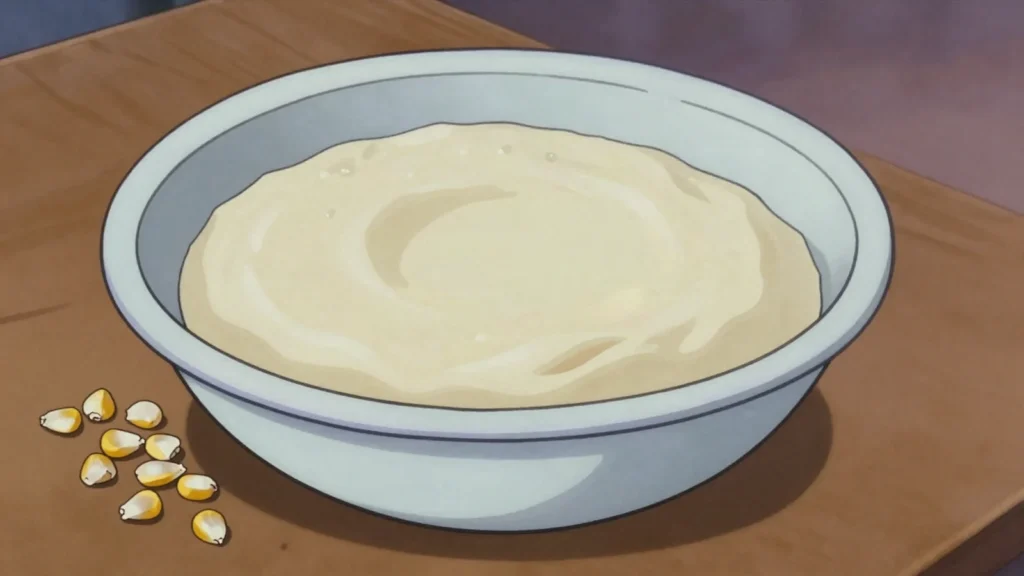
- Add as little water as the mill needs. A wet paste is harder to handle and ferments faster. Work it into a firm dough. Pack it into a container.
- Mix in a spoonful of mawè from a previous batch. It takes longer and it is less predictable.
- Cover it with a cloth or a loose lid. Keep it warm. Pour it off or stir it back in. Either is done. Taste a little. It should be pleasantly sour, like sourdough.
- Discard it if anything is wrong. Do not scrape it and continue. Keep back a spoonful before you use the rest. Keep it covered and refrigerated between batches. The dough is cooked to a stiff paste and wrapped in leaves.
Technique
- The hazard here is the maize rather than the ferment. Maize stored warm and damp grows moulds that produce mycotoxins — aflatoxin, a documented liver carcinogen, and fumonisin. Cooking does not destroy them and fermentation reduces without removing them, so sorting the grain is the control: discard anything discoloured, shrivelled, mouldy, dusty, musty-smelling, broken or insect-damaged. Hand sorting maize measurably reduces aflatoxin — a documented finding rather than folklore.
- Buy from a shop with dry, clean, well-turned-over stock, and store dry maize somewhere dry and airy. Damp storage is where the problem starts.
- This is a lactic cereal fermentation, which acidifies quickly and suppresses what you do not want, making it one of the more forgiving ferments. The atlas declines to instruct on some ferments on safety grounds and this is not one of them — saying so keeps the other warnings meaningful.
- Keep back a spoonful before using the rest. Back-slopping carries the established bacterial population so the next batch starts immediately and comes out consistent — the same principle as a bread starter, and how a household culture runs for years. A first batch without one ferments on the grain’s own bacteria, more slowly and less predictably.
- Do not seal the container. Fermentation produces gas and a sealed container builds pressure.
- Removing the germ gives a whiter, longer-keeping dough because the germ’s oil goes rancid — but it also removes nutrients, which is a real trade-off rather than a pure improvement.
- Add as little water as the mill needs. A wet paste is harder to handle and ferments faster, and gritty dough gives gritty akassa.
- It wants twenty-five to thirty degrees, which is what it gets in Benin. In a cooler kitchen give it longer, or use an oven with only the light on.
- Liquid separating on the surface is normal; pour it off or stir it back in, both are done.
- Judge it by smell and taste: pleasantly sour like sourdough is right. Putrid or ammoniac is not, and any coloured or fuzzy surface mould means discard the whole batch rather than scraping and continuing.
- Lactic fermentation of cereals reduces phytates, which bind iron and zinc, so it improves mineral availability. Fermented cereal porridges are used as weaning foods across the region, and their acidity is a genuine safety advantage over unfermented ones — the atlas records that and makes no feeding recommendation.
- The sourness is the point rather than a fault to be corrected with sugar alone.
- Maize contains no gluten, but may be milled where other grains are milled — anyone strictly avoiding it should ask.
Substitutions
- Yellow maize replaces white and gives a darker dough.
- Fine maize meal replaces whole grain, at some cost in texture and flavour.
- Sorghum or millet ferment the same way across the region.
- A spoonful of any live sour cereal dough works as a starter.
- Ogi and koko in Nigeria and Ghana are the same idea under other names.
- Commercially milled maize dough is sold in African grocers abroad.
Variations
- Akassa cooks and wraps it into steamed parcels.
- Aklui rolls it into small granules.
- Ogi and koko are the porridge forms.
- A thinned sweetened drink is made from the same dough.
- Ogi baba uses sorghum instead of maize.
- A longer ferment gives a sharper dough for a sour porridge.
History
A southern Beninese household ferment studied by food scientists as a lactic maize dough; it is kept back to inoculate each new batch.
Frequently asked questions
What is Mawè?
Mawè is a fermented & pickled from Benin: sour fermented maize dough, the mother base for akassa and drinks. A southern Beninese household ferment studied by food scientists as a lactic maize dough; it is kept back to inoculate each new batch.
How long does Mawè take to make?
Mawè takes 30 minutes plus 2 days of preparation and none of cooking. The recipe makes makes about 1.5 kg. It is rated medium to make.
What can I substitute in Mawè?
Yes, within limits. Yellow maize replaces white and gives a darker dough. Fine maize meal replaces whole grain, at some cost in texture and flavour. Sorghum or millet ferment the same way across the region. A spoonful of any live sour cereal dough works as a starter. Ogi and koko in Nigeria and Ghana are the same idea under other names. Commercially milled maize dough is sold in African grocers abroad.
What is the most important thing to get right in Mawè?
Discard it if anything is wrong. Do not scrape it and continue. Keep back a spoonful before you use the rest. Keep it covered and refrigerated between batches. The dough is cooked to a stiff paste and wrapped in leaves.