
Ingredients
Dough
- 700 gstrong white flour
- 400 mlwarm water
- 10 gdried yeast
- 40 gsugar
- 2 teaspoonssalt
- 60 mlolive oil
- 1 teaspoonbread improver, optional
To coat
- 150 gsesame seeds
- 150 mlwater
- 2 tablespoonssugar
- or a thin sugar syrup
To serve
- boiled eggs
- za’atar, in a twist of paper
- falafel
- hummus
- sweet tea
Directions
- Salt goes into the blend as well. The bread should be soft inside. Warm the water to just above body temperature. It should feel barely warm to a clean finger.
- Stir the yeast and a spoon of sugar into it. Let it stand five minutes until it foams. Combining it takes only a moment. Put the flour, sugar and salt in a bowl. Whisk them together thoroughly. Add the yeasted water to the bowl.
- Add the olive oil to it as well. Bring it together into a soft dough. Turn it out onto a floured surface. Knead it for a good ten minutes. It should become smooth and elastic.
- Put the dough in an oiled bowl. Cover it over with a clean cloth. Leave it somewhere warm to rise. It should roughly double in size. Divide it into six equal pieces. Roll each one into a smooth ball.
- Let them rest ten minutes covered. Forming the ring takes practice. Roll a ball into a thick rope. Press the join firmly to seal it. Work it gently with both hands. Pull it out to about thirty centimetres. Let the dough relax between pulls. The hole should stay open through the middle.
- Mix the water and sugar into a thin syrup. Brush or dip each ring in that syrup. Turn it and press the other side. Coat each one thickly all over. It also helps the crust colour in the oven. Set the coated rings on lined trays.
- Cover them over and let them rise. Give them about thirty minutes. Heat the oven as hot as it will go. Bake them for about fifteen minutes. Judging them takes a careful look. Take them out while still slightly soft. Set them on a rack for ten minutes. They firm up as they cool down.
Technique
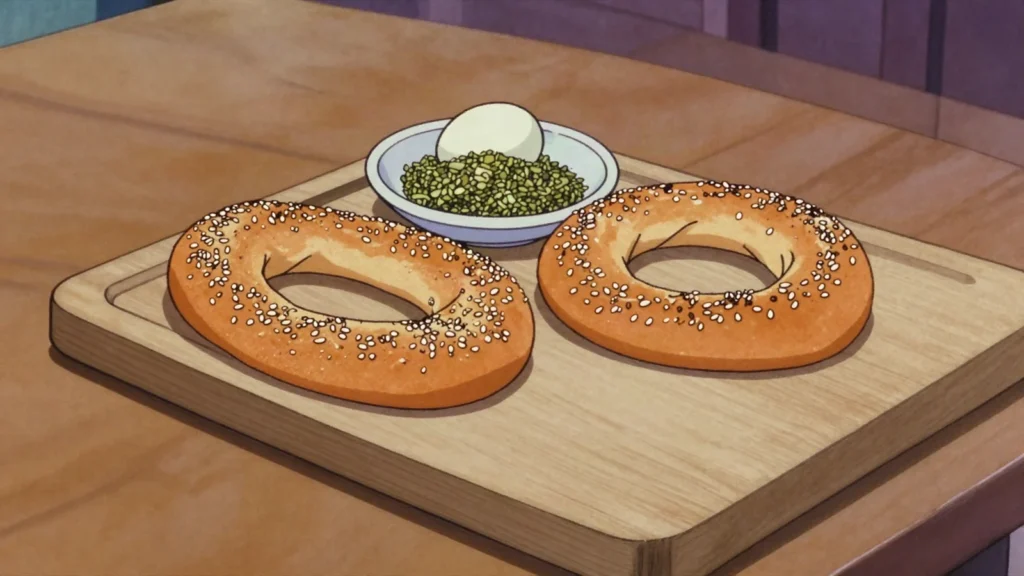
- The ring is a long stretched oval rather than a circle, sometimes forty centimetres long with the hole running its length, and sellers carry them stacked in tall towers on wooden trays balanced on the head or wheeled on carts through the Old City.
- A small paper twist of za’atar comes with the bread and a boiled egg is often given as well, which together make the standard cheap street breakfast.
- Strong bread flour is needed because its gluten lets the ring be stretched long, while weak flour tears; stretch slowly and let the dough relax between pulls, since pulling hard tears it or springs it back.
Substitutions
- Any strong white bread flour works, and plain flour tears when stretched.
- Water alone can replace the sugar syrup, though it holds fewer seeds.
Variations
- It is eaten with boiled egg and za’atar or split and filled with falafel.
- Some bakers make it shorter and thicker and others very long and thin.
- Ka’ak of other shapes is baked across the Levant.
History
Long sesame bread ring sold in Jerusalem’s Old City, eaten with boiled eggs and a twist of za’atar.
Frequently asked questions
What is Ka’ak al-Quds?
Ka’ak al-Quds is a street food from Palestine: oblong sesame bread rings from Jerusalem carts, with falafel or za’atar. Long sesame bread ring sold in Jerusalem’s Old City, eaten with boiled eggs and a twist of za’atar.
How long does Ka’ak al-Quds take to make?
Ka’ak al-Quds takes 40 minutes plus rising of preparation and 25 minutes of cooking. The recipe makes 6 large rings. It is rated medium to make.
What can I substitute in Ka’ak al-Quds?
Yes, within limits. Any strong white bread flour works, and plain flour tears when stretched. Water alone can replace the sugar syrup, though it holds fewer seeds.
What is the most important thing to get right in Ka’ak al-Quds?
The ring is a long stretched oval rather than a circle, sometimes forty centimetres long with the hole running its length, and sellers carry them stacked in tall towers on wooden trays balanced on the head or wheeled on carts through the Old City.