
Ingredients
The grub
- witchetty grubs, the larvae of the wood moth Endoxyla leucomochla
To cook
- hot ashes and coals, traditionally
- or a dry pan
Optional
- a pinch of salt, which is not traditional
To serve
- straight from the ashes
Equipment
- a digging stick, traditionally
- a fire
Directions
- The witchetty grub is a fat wood-moth larva dug from roots, and it was a staple protein for Aboriginal desert communities, traditionally gathered by women.
- It is the larva of Endoxyla leucomochla, which feeds on the roots of the witchetty bush, Acacia kempeana, in the arid centre of Australia.
- The name comes from an Adnyamathanha word, and the grub is significant in Arrernte and other Central Australian cultures well beyond its food value.
- Now the most important thing to say, which is about whose food and whose knowledge this is.
- Finding witchetty grubs is skilled work. The signs are subtle: a particular bush, cracks in the soil, damage at the base, and knowing which roots to dig.
- That knowledge belongs to Aboriginal people and has been developed and taught over thousands of years, and gathering is traditionally women’s work done in groups.
- This is not something to go and dig up on a whim, and on much of the relevant country you would need permission in any case.
- It is worth understanding as a food rather than treating as a novelty or a dare, which is how it is too often presented.
- Now an allergy note, which is genuine.
- Edible insects share allergenic proteins with crustaceans, particularly tropomyosin.
- Anyone with a shellfish or dust mite allergy may react to insects, and should treat them with the same caution. This is documented and it applies across the whole category.
- Now the grub itself, and what to look for.
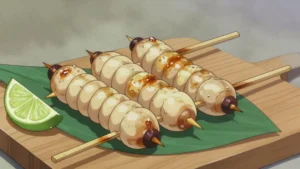
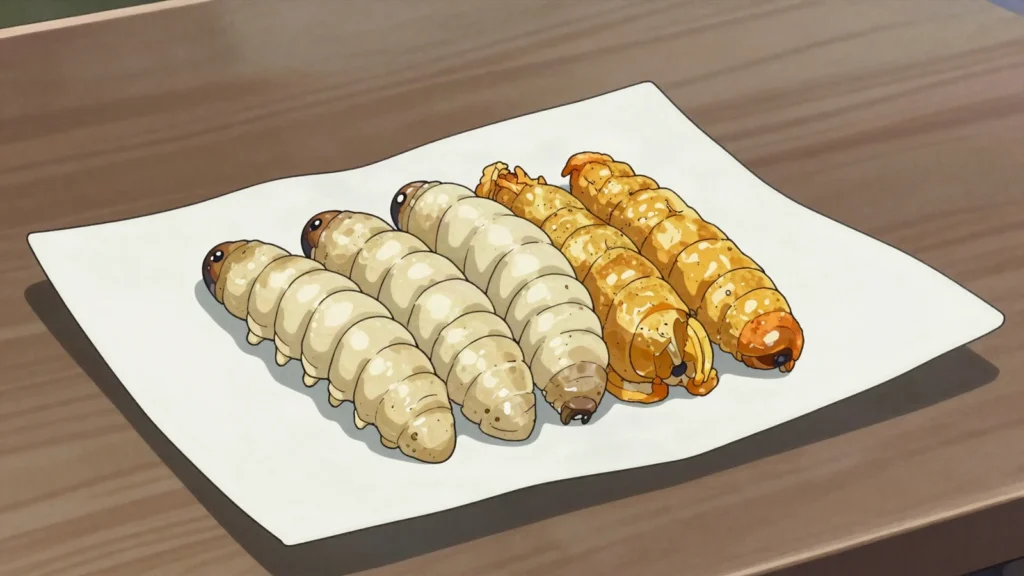
- It is large, pale cream and soft, several centimetres long, with a darker head.
- It should be plump and firm and it should move. A limp or discoloured grub is dead and is not eaten.
- It is eaten in two ways and both are traditional.
- Now raw, which is how they are often eaten as they are dug.
- Eaten raw, the grub is soft with a texture people compare to a raw egg yolk or to almond cream, and the flavour is mild and nutty.
- It is usually eaten head first, and the head is sometimes pinched off first.
- This is genuinely common practice while gathering, and children eat them this way.
- Now cooked, which changes it entirely.
- Roast them briefly in hot ashes and coals, not in flames.
- Push them into the hot ash at the edge of a fire and turn them, for only a minute or two.
- They cook extremely fast. A minute or so is enough, and left longer they burst, dry out and lose everything that makes them good.
- They are ready when the skin is lightly crisp and slightly browned and the grub has firmed.
- The inside becomes creamy rather than liquid.
- Cooked, they taste noticeably of scrambled egg and roasted nuts, and the skin crisps like a very thin crackling.
- That combination of a crisp skin and a soft nutty interior is what people describe, and it is regularly said to be far better than expected.
- A dry pan over a fire does the same job if you have no ashes.
- No seasoning is traditionally added and none is needed.
- Now the nutrition, which is the reason it mattered.
- They are very high in fat and protein and in a desert environment they were a dense, reliable food source.
- A handful represents a substantial amount of energy, which is exactly what a foraging economy in arid country needs.
- They are seasonal and they are gathered when available rather than farmed.
- Now a note on what is sold commercially.
- Much of what is sold or served as witchetty grub in Australian restaurants is a different species, often a farmed wood moth larva, and it is not always the true desert grub.
- That is worth knowing, since the genuine article is difficult to obtain and is largely gathered for community use rather than trade.
- There have been efforts to develop supply that benefits Aboriginal communities directly, which is the right direction.
- It is one of the best known Aboriginal foods internationally and it is also one of the most misrepresented.
Technique
- Insects share allergenic proteins with crustaceans and shellfish.
- Locating them is skilled Aboriginal knowledge, traditionally women’s work.
- Much of what is served commercially is a different species.
Substitutions
- There is no substitute, and it is not a dish to approximate.
- Other edible larvae are eaten across the world on similar principles.
Variations
- Eaten raw, as they are gathered.
- Roasted briefly in hot ashes.
- Cooked in a dry pan.
History
A staple protein for Aboriginal desert communities, dug from the roots of the witchetty bush and traditionally gathered by women.
Frequently asked questions
What is Witchetty Grub?
Witchetty Grub is a snack from Australia: fat wood-moth larva dug from roots, eaten raw or roasted until nutty and crisp. A staple protein for Aboriginal desert communities, dug from the roots of the witchetty bush and traditionally gathered by women.
How long does Witchetty Grub take to make?
Witchetty Grub takes 5 min of preparation and 5 min of cooking. The recipe makes varies. It is rated medium to make.
What can I substitute in Witchetty Grub?
Yes, within limits. There is no substitute, and it is not a dish to approximate. Other edible larvae are eaten across the world on similar principles.
What is the most important thing to get right in Witchetty Grub?
It is worth understanding as a food rather than treating as a novelty or a dare, which is how it is too often presented.