
Ingredients
Sausage
- 900 gpork shoulder with its fat, about 80% lean to 20% fat
- 2 tspsalt
- 2 tbspcoarsely ground black pepper
- 1 tspwhite pepper
- ½ tspground mace
- ½ tspground nutmeg
- 1 tspdried sage, optional
- 80 grusk or fresh breadcrumbs
- 120 mlvery cold water
- natural hog casing, about 1.5 m
To serve
- mashed potato
- onion gravy
- apple sauce
Directions
- Cut the pork into 2 cm dice and chill it thoroughly, then chop it coarsely — by hand or through the widest plate of a mincer.
- Coarse is the defining feature. A Cumberland sausage should show visible pieces of meat when it is cut, and putting the pork through a fine plate makes an ordinary banger.
- Keep everything cold throughout. If the fat warms it smears rather than staying in distinct pieces, and the cooked sausage turns greasy and crumbly.
- Mix in the salt, both peppers, mace, nutmeg and sage, then the rusk and the cold water. The pepper quantity looks excessive and is not — this is a peppery sausage and always has been.
- Fry a teaspoon of the mixture and taste it before you go any further.
- Fill the casing in one continuous length without twisting it into links, and wind it into a flat spiral.
- The unlinked coil, sold by length rather than by the sausage, is written into the PGI specification for Traditional Cumberland Sausage along with the minimum 80 percent meat content.
- Pin the coil with two skewers crossed through it so it holds together in the pan.
- Fry gently in a little dripping over medium-low heat for 30 to 35 minutes, turning once with the help of a plate, until deep brown and cooked to 71°C (160°F) in the centre.
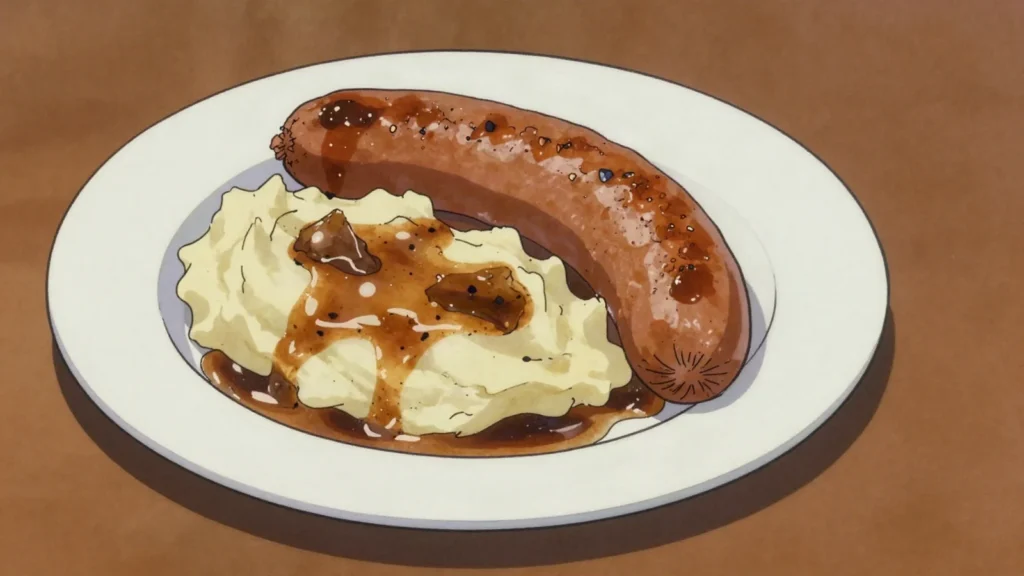
- Low heat throughout. A hot pan splits the casing and the juices go into the pan instead of the sausage. Serve in wedges with mash, onion gravy and apple sauce.
Technique
- Coarse chop, cold meat, heavy on the pepper.
- One long coil, never linked.
- Thirty-five minutes over medium-low heat, to 71°C (160°F).
Substitutions
- Formed into flat patties if you have no casings.
- Baked at 180°C (350°F) for 35 minutes, which is easier to manage than turning a coil.
- Herbs left out entirely, which the strictest Cumberland makers prefer — pepper and mace alone.
Variations
- Toad in the hole, with the coil baked into batter.
- The Lincolnshire sausage is its sage-heavy cousin.
History
Traditional Cumberland Sausage gained PGI protection in 2011, requiring at least eighty percent meat and the unlinked coil sold by weight.
Frequently asked questions
What is Cumberland sausage?
Cumberland sausage is a charcuterie & cured from United Kingdom: long coiled pork sausage, coarsely chopped and peppery, sold by the length. Traditional Cumberland Sausage gained PGI protection in 2011, requiring at least eighty percent meat and the unlinked coil sold by weight.
How long does Cumberland sausage take to make?
Cumberland sausage takes 45 min of preparation and 35 min of cooking. The recipe makes makes one 1 kg coil, serving 4. It is rated medium to make.
What can I substitute in Cumberland sausage?
Yes, within limits. Formed into flat patties if you have no casings. Baked at 180°C (350°F) for 35 minutes, which is easier to manage than turning a coil. Herbs left out entirely, which the strictest Cumberland makers prefer — pepper and mace alone.
What is the most important thing to get right in Cumberland sausage?
Keep everything cold throughout. If the fat warms it smears rather than staying in distinct pieces, and the cooked sausage turns greasy and crumbly.