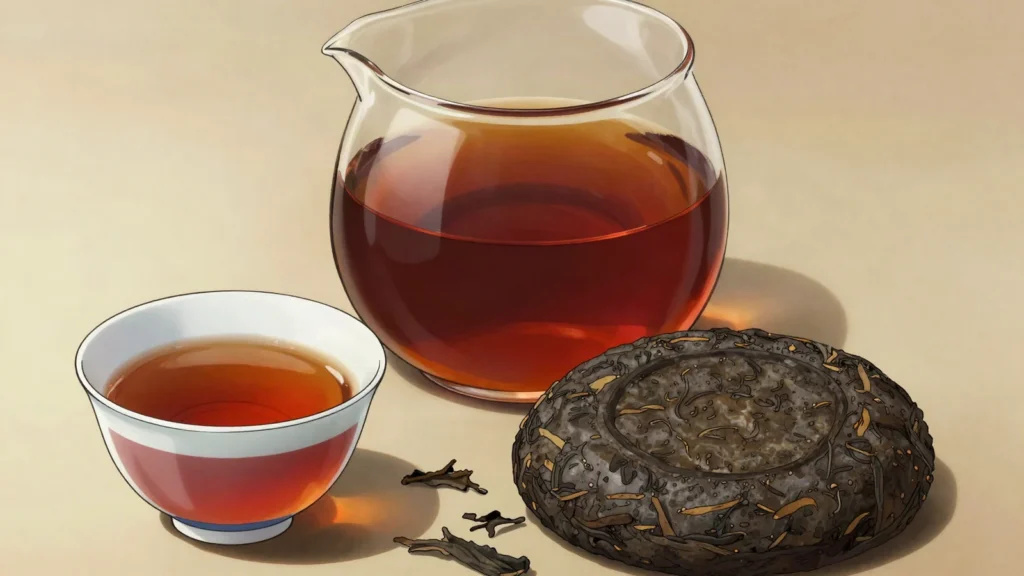

Ingredients
Leaf
- 7 gpu-erh, broken carefully from a 357 g bing (cake), tuocha or brick
- Large-leaf Camellia sinensis var. assamica from Yunnan, ideally with a named mountain: Yiwu, Bulang, Jingmai, Banzhang
Water
- 150 mlspring or filtered soft water, at a full 100°C (200°F)
- Hard water flattens the aroma and makes young sheng taste metallic
Equipment
- 1gaiwan or yixing pot, 100–150 ml
- 1fairness pitcher (gongdao bei)
- Small tasting cups, 30–40 ml
- A pu-erh pick or thin knife
- A kettle you can keep at the boil
Directions
- Warm the gaiwan, pitcher and cups with boiling water and discard it; a cold vessel drops the brewing temperature immediately.
- Add the 7 g of leaf to the warm gaiwan, cover, and smell the dry leaf as the residual heat wakes it up: sheng smells of hay and stone fruit, shou of wet wood and dark earth.
- Rinse: fill with boiling water, wait 5 seconds, discard.
- Add 3–5 seconds to each subsequent infusion. Good pu-erh gives 10–15 infusions, evolving from sharp and floral to sweet and thick; stop when the liquor goes pale and woody.
Technique
- Pu-erh must legally come from designated areas of Yunnan and be made from large-leaf assamica. It is the one Chinese tea deliberately aged, and value is claimed by storage as much as by harvest.
- Storage matters more than most buyers realise: 60–75% humidity and stable temperature, away from strong smells, unwrapped from plastic. Wet-stored cakes develop mustiness that some drinkers prize and others consider spoilage.
- Young sheng is astringent and can be hard on an empty stomach; shou and aged sheng are gentler.
Substitutions
- No gaiwan? Use a small teapot, or brew grandpa style: 5 g leaf loose in a tall glass, topped up with hot water all day.
- Loose-leaf shou pu-erh is far cheaper than cakes and is a fair way to learn the style before buying pressed tea.
Variations
- Xiaoqing gan stuffs shou into a hollowed green mandarin and dries it, giving a citrus-scented brew.
- Yunnan tea houses also serve pu-erh boiled in a kettle with the leaves, a thicker, sweeter preparation used for older shou.
History
Traded along the Yunnan-Tibet Tea Horse Road from the Tang era; compressed cakes carried by mule fermented en route, creating the aged style.
Frequently asked questions
What is Pu-erh Tea?
Pu-erh Tea is a drink from China: yunnan dark tea pressed into cakes and aged for years, earthy and mellow. Traded along the Yunnan-Tibet Tea Horse Road from the Tang era; compressed cakes carried by mule fermented en route, creating the aged style.
How long does Pu-erh Tea take to make?
Pu-erh Tea takes 5 min of preparation and Sheng: months to decades of ageing. Shou: 45–60 days of pile fermentation of cooking. The recipe makes 6–8 small cups from one gaiwan session. It is rated medium to make.
What can I substitute in Pu-erh Tea?
Yes, within limits. No gaiwan? Use a small teapot, or brew grandpa style: 5 g leaf loose in a tall glass, topped up with hot water all day. Loose-leaf shou pu-erh is far cheaper than cakes and is a fair way to learn the style before buying pressed tea.
What is the most important thing to get right in Pu-erh Tea?
Pu-erh must legally come from designated areas of Yunnan and be made from large-leaf assamica. It is the one Chinese tea deliberately aged, and value is claimed by storage as much as by harvest.