
Ingredients
Brine
- 4 litreswater
- 480 gfine salt
- 40 gcuring salt (nitrite salt, 0.6%)
- 150 gsugar
- 2 tbspblack peppercorns
- 6bay leaves
- 1 tbspjuniper berries
- 1 headgarlic, halved
Ham
- 3 kgboneless pork leg, in one piece
- butcher’s string
To finish
- beechwood chips, if you have a smoker
- or 2 tbsp honey and 1 tbsp mustard, for the oven version
Directions
- Bring 1 litre of the water to a boil with all the salt, curing salt, sugar and aromatics, stir until dissolved, then add the remaining 3 litres cold and chill the brine to below 5°C (41°F). Warm brine on raw pork is the one thing that must never happen.
- Weigh the curing salt exactly. It is what keeps a large piece of meat safe through a week in brine and gives the pink colour and the cured flavour; guessing it is not an option in either direction.
- Submerge the pork completely in the cold brine, weighted down, and refrigerate for seven days. Turn it daily.
- For an even cure, inject some of the brine deep into the muscle with a brining syringe on day one. Without it a 3 kg piece cures from the outside in and the centre stays grey and bland.
- After seven days, lift the ham out, rinse it well and soak in fresh cold water for two hours to draw back the surface salt.
- Tie it firmly into an even cylinder with string, then cook it gently — either hot-smoked over beech at 75°C (167°F), or in a low oven at 90°C (194°F) in a covered tin with a little water — until the centre reaches 68°C (154°F). This takes about four hours. Use a probe thermometer; there is no other way to know.
- Cool completely, ideally overnight in the fridge, before carving. Warm, it crumbles; cold, it slices cleanly.
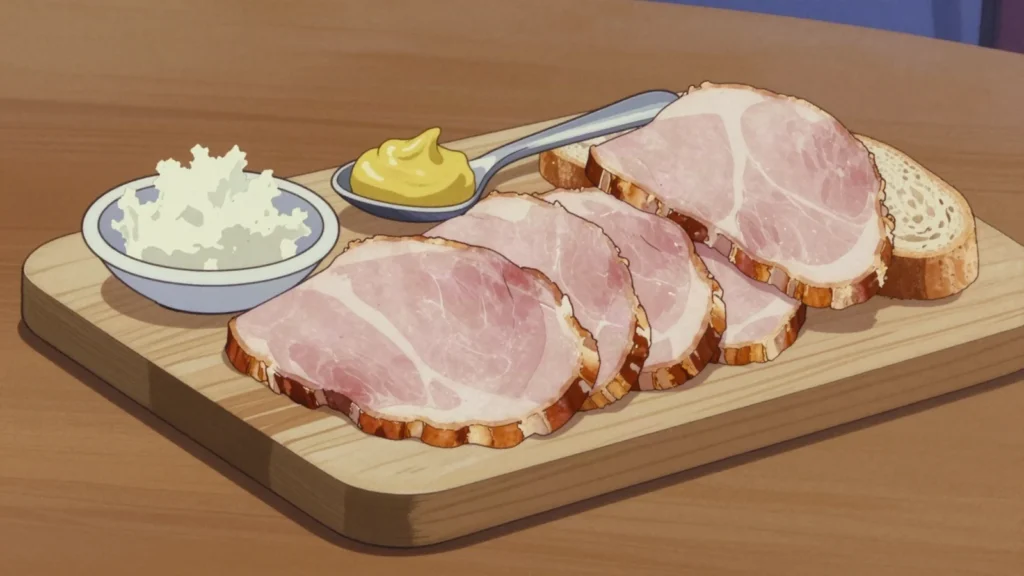
- Carve thin and serve with bread, horseradish and mustard, or brush the oven version with honey and mustard and glaze it for 15 minutes at 200°C (400°F).
Technique
- Curing salt is not ordinary salt and the two are not interchangeable. Use a proper nitrite blend at the stated rate and keep it away from anything else.
- Cook to a core temperature, not to a time. A 3 kg ham can vary by an hour depending on its shape.
- The two-hour desalting soak matters. Skip it and the outside is a salt lick while the middle is right.
Substitutions
- A smaller 1.5 kg piece, brined for four days rather than seven, which is far more manageable.
- Pork shoulder for a fattier, more forgiving ham.
- Liquid smoke brushed on before the oven, if there is no smoker.
Variations
- The bone-in version cooked on the bone and carved at the table is the traditional Prague ham.
- Sliced thin into a Czech obložené chlebíčky with potato salad and egg.
History
Created in Prague in 1857 by butcher František Zvěřina, whose brined and beech-smoked ham was exported across the Austro-Hungarian empire.
Frequently asked questions
What is Pražská šunka?
Pražská šunka is a charcuterie & cured from Czechia: mild brined ham smoked over beechwood, carved from the bone. Created in Prague in 1857 by butcher František Zvěřina, whose brined and beech-smoked ham was exported across the Austro-Hungarian empire.
How long does Pražská šunka take to make?
Pražská šunka takes 40 min plus 7 days brining of preparation and 4 hours of cooking. The recipe makes serves 10. It is rated hard to make.
What can I substitute in Pražská šunka?
Yes, within limits. A smaller 1.5 kg piece, brined for four days rather than seven, which is far more manageable. Pork shoulder for a fattier, more forgiving ham. Liquid smoke brushed on before the oven, if there is no smoker.
What is the most important thing to get right in Pražská šunka?
Bring 1 litre of the water to a boil with all the salt, curing salt, sugar and aromatics, stir until dissolved, then add the remaining 3 litres cold and chill the brine to below 5°C (41°F). Warm brine on raw pork is the one thing that must never happen.