
Ingredients
The leg
- 1hind leg of pure or crossbred Iberian pig, 11–14 kg fresh, from an animal finished on acorns in the dehesa
Salting and curing
- 40 kgcoarse sea salt, enough to bury the leg completely
- a cold room at 0–4 C and 80–90 percent humidity, for salting and settling
- a natural drying loft (secadero) with shuttered windows
- a cool cellar (bodega) at 15–20°C (60–70°F)
To carve and serve
- 1jamonero (ham holder)
- 1long, thin, flexible carving knife
- 1short, rigid boning knife
- warm plates, and bread and a glass of fino alongside
Directions
- Trim the fresh leg, press out residual blood from the artery, and bury it completely in coarse sea salt in a cold room at 0–4 C.
- Salt for roughly one day per kilogram of leg weight.
- Brush off all the salt, wash briefly in cold water and hang the leg to equalise at 3–6 C and high humidity for 40 to 60 days, so the salt migrates evenly from the surface to the bone.
- Transfer the leg to the cool, humid bodega and let it age slowly for a further 12 to 30 months. Test with a cala, a thin needle of cow bone, pushed into three points near the joints and sniffed.
- Strip off the outer rind and yellowed fat only from the area you will carve that day.
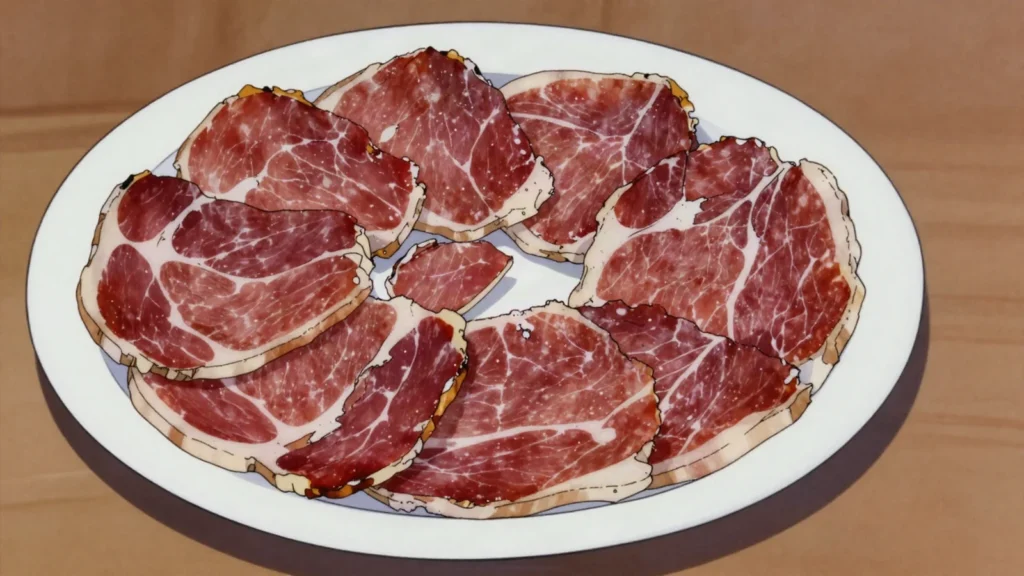
- Carve almost horizontally with the long knife into slices 5–6 cm long, wafer thin and nearly translucent, each with its rim of fat left on.
- Lay them flat and barely overlapping on a warm plate and serve at 20–24°C (70–75°F) so the fat begins to shine. Never chill it and never machine-slice it.
Technique
- The labels are legally defined by colour tag: black for 100 percent ibérico de bellota, red for crossbred ibérico de bellota, green for cebo de campo and white for cebo. Bellota means the pig was acorn-finished.
- Serving temperature is everything. Straight from the fridge the fat is waxy and mute; at 22°C (70°F) it turns glossy and releases the aroma the whole three years were for.
- Home curing a whole leg is a serious undertaking that needs stable cold, controlled humidity and months of attention. Attempted in a warm kitchen it is genuinely dangerous.
Substitutions
- No whole leg: buy a shoulder (paleta), which is smaller, cheaper, cures in about 18 months and is slightly more fibrous.
- Vacuum-packed hand-carved slices are a legitimate compromise; open the pack 20 minutes before serving and spread the slices out to breathe.
- Jamón serrano, from white pig breeds, is cured the same way and is the everyday alternative, leaner and less complex.
Variations
- Jamón de Guijuelo, Jabugo, Dehesa de Extremadura and Los Pedroches, the four protected designations, each with its own climate and character.
- Served in a bocadillo with tomato-rubbed bread, or draped over hot pan con tomate so the fat softens.
History
Dry-cured ham, made specifically from the black Iberian pig, a breed native to the Iberian Peninsula, cured and aged for an extended period ranging from one to several years, documented across Spain for many centuries as one of the country’s most prized and culturally significant foods. Its quality and flavour are closely tied to the specific diet of the Iberian pigs used, with the most highly prized grade, called jamón ibérico de bellota, coming from pigs that free-range and feed primarily on acorns during the finishing period before slaughter, a practice regulated and certified under Spanish law. Jamón ibérico remains one of Spain’s most internationally celebrated and highly regarded culinary products.
Frequently asked questions
What is Jamón ibérico?
Jamón ibérico is a charcuterie & cured from Spain: acorn-fed cured ham hand-carved wafer thin. Dry-cured ham, made specifically from the black Iberian pig, a breed native to the Iberian Peninsula, cured and aged for an extended period ranging from one to several years, documented across Spain for many centuries as one of the country’s most prized and culturally significant foods. Its quality and flavour are closely tied to the specific diet of the Iberian pigs used, with the most highly prized grade, called jamón ibérico de bellota, coming from pigs that free-range and feed primarily on acorns during the finishing period before slaughter, a practice regulated and certified under Spanish law. Jamón ibérico remains one of Spain’s most internationally celebrated and highly regarded culinary products.
How long does Jamón ibérico take to make?
Jamón ibérico takes 2 hr active work over 3 years of preparation and 24 to 48 months curing of cooking. The recipe makes 1 ham of 7–9 kg, about 60 servings. It is rated hard to make.
What can I substitute in Jamón ibérico?
Yes, within limits. No whole leg: buy a shoulder (paleta), which is smaller, cheaper, cures in about 18 months and is slightly more fibrous. Vacuum-packed hand-carved slices are a legitimate compromise; open the pack 20 minutes before serving and spread the slices out to breathe. Jamón serrano, from white pig breeds, is cured the same way and is the everyday alternative, leaner and less complex.
What is the most important thing to get right in Jamón ibérico?
Lay them flat and barely overlapping on a warm plate and serve at 20–24°C (70–75°F) so the fat begins to shine. Never chill it and never machine-slice it.