
Ingredients
Soup
- 800 gfloury potatoes, peeled and roughly chopped
- 1large onion, chopped
- 4garlic cloves, sliced
- 1.7 litreswater
- 80 mlolive oil, plus more to finish
- 2 tspsalt
Greens and sausage
- 300 gcouve galega or dark cavolo nero, stems stripped out
- 150 gchouriço de carne, sliced 3 mm thick on the angle
To serve
- broa de milho (Portuguese cornbread)
- coarse salt and a bottle of good olive oil on the table
Directions
- Put the potatoes, onion, garlic, salt, water and half the olive oil in a pot and boil for 20–25 minutes, until the potato is falling apart.
- Meanwhile prepare the greens: stack the leaves, roll them into a tight cigar and slice as fine as you possibly can, under 2 mm. This is the whole craft of the dish, which is why Portuguese shops sell it ready-shredded.
- Fry the chouriço slices dry in a small pan, 2 minutes a side, until the fat runs orange and the edges curl. Lift the slices out and keep the coloured fat.
- Blend the soup completely smooth with a stick blender, with no lumps at all, then thin it with water to the consistency of single cream. It should pour, not sit in a mound.
- Bring it back to a rolling boil, drop in the shredded greens and cook uncovered for 4–5 minutes only, until tender but still bright green.
- Stir in the remaining olive oil and the chouriço fat and check the salt. Serve at once: the green dulls to olive within minutes of sitting.
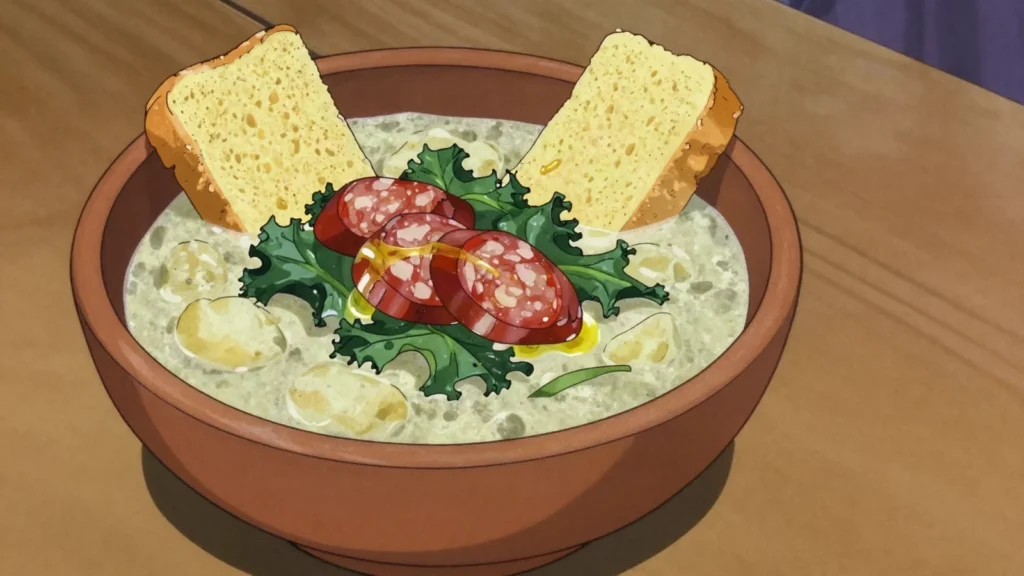
- Ladle into bowls, lay 2–3 slices of chouriço on each, pour a thread of raw olive oil over the top and serve broa alongside.
Technique
- Caldo verde comes from the Minho in the north and is the soup of festas and weddings, ladled out at midnight after the dancing as often as at the start of a meal.
- Never blend the greens or cook them long. The contrast between the smooth, pale base and the fine, still-firm green ribbons is the entire dish.
- Olive oil is a seasoning here and not just a cooking fat. The raw pour at the end matters as much as the oil that went into the pot.
- Do not thicken with flour or cream. The potato is the thickener and the soup should be light enough to drink from the bowl.
Substitutions
- No couve galega: cavolo nero first, then collard greens, then savoy, each progressively sweeter and softer, and all cut just as fine.
- No chouriço: a smoked paprika sausage, plus half a teaspoon of smoked paprika bloomed in the oil to make up the colour.
Variations
- Some Minho households add a splash of the water the chouriço was poached in for extra depth.
- In Trás-os-Montes a slice of morcela sometimes joins the chouriço on top.
- A version without sausage, leaning on more garlic and a heavier pour of olive oil, is common in Lent.
History
A simple soup of thinly shredded collard-style greens called couve galega, potato and often a slice of chourico sausage, generally considered Portugal’s national soup and most strongly associated with the northern Minho region, where the specific dark green couve galega has long been cultivated and where the technique of shredding it into extremely fine, hair-thin ribbons is treated as a genuine mark of a properly made caldo verde. Its base of potato and greens reflects a historically frugal, practical peasant dish built on inexpensive, reliably available ingredients rather than an elaborate recipe, and caldo verde carries particular cultural significance tied to Portuguese festas, or village festivals, where it is traditionally served in large communal quantities to visitors and participants.
Frequently asked questions
What is Caldo verde?
Caldo verde is a soup & stew from Portugal: collard-and-potato soup with chouriço slices. A simple soup of thinly shredded collard-style greens called couve galega, potato and often a slice of chourico sausage, generally considered Portugal’s national soup and most strongly associated with the northern Minho region, where the specific dark green couve galega has long been cultivated and where the technique of shredding it into extremely fine, hair-thin ribbons is treated as a genuine mark of a properly made caldo verde. Its base of potato and greens reflects a historically frugal, practical peasant dish built on inexpensive, reliably available ingredients rather than an elaborate recipe, and caldo verde carries particular cultural significance tied to Portuguese festas, or village festivals, where it is traditionally served in large communal quantities to visitors and participants.
How long does Caldo verde take to make?
Caldo verde takes 15 min of preparation and 40 min of cooking. The recipe makes 6 servings. It is rated easy to make.
What can I substitute in Caldo verde?
Yes, within limits. No couve galega: cavolo nero first, then collard greens, then savoy, each progressively sweeter and softer, and all cut just as fine. No chouriço: a smoked paprika sausage, plus half a teaspoon of smoked paprika bloomed in the oil to make up the colour.
What is the most important thing to get right in Caldo verde?
Meanwhile prepare the greens: stack the leaves, roll them into a tight cigar and slice as fine as you possibly can, under 2 mm. This is the whole craft of the dish, which is why Portuguese shops sell it ready-shredded.