
Ingredients
Ham
- 1whole fresh pork hind leg, 11–13 kg, from a heavy mature pig, aitchbone removed, rind and foot left on
Cure
- 6–8 kgcoarse Adriatic sea salt, ungrained and unrefined
- 2 tbspcoarsely ground black pepper (optional, for the exposed muscle)
Smoke and dry
- 20–30 kgdry beech and hornbeam wood, plus a few juniper branches
- Clean cotton cloth and a weight of about 40 kg (stone slab)
- Lard or a lard-and-flour paste, to seal the cut face
Directions
- Chill the fresh leg to 2–4 C for 24 hours, trim it to the rounded Njegusi shape, and press out any blood remaining in the femoral artery by working from the hock down towards the cut face. Dry-salt it: bed the leg in coarse sea salt in a wooden or plastic trough, rind down, and bury it completely.
- Hold the room at 2–6 C.
- Cure for roughly one day per kilo, 12–15 days for a 12 kg leg, restacking and re-salting once at the halfway point and pouring off the brine that runs out.
- Brush off all the salt, press the leg under a stone weight for 3–5 days at the same temperature to flatten it and expel the last free liquid, then hang it. Cold-smoke it in the smokehouse over a small smouldering beech fire, never above 20°C (70°F), working only during daylight and letting it rest at night.
- Continue for 3–4 months through winter. The smoke phase is finished when the surface is dry, deep amber-brown and firm to the thumb, and the ham has lost about 20 percent of its start weight.
- Seal any exposed muscle with lard once the surface hardens, to stop the outside case-hardening ahead of the centre. The ham is ready when it has lost 33–38 percent of its green weight, feels hard with a slight give at the hock, and a horn or bamboo probe pushed into the joints comes out smelling sweet and nutty with no sourness.
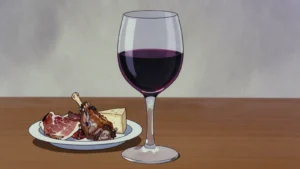
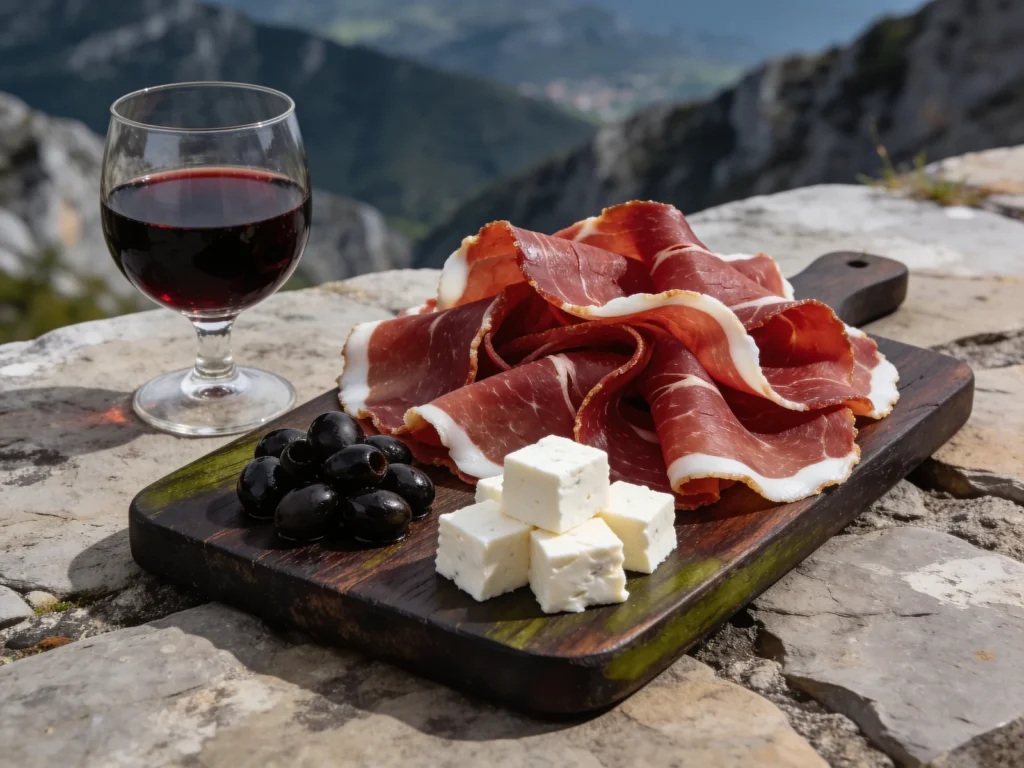
- Serve it hand-sliced almost paper-thin at room temperature, with Njegusi cheese, olives and a glass of Vranac.
Technique
- Njeguski prsut is defined by two things: cold beech smoke, which sets it apart from unsmoked Dalmatian and Italian hams, and the specific air of the Njegusi plateau at 800 m, which is why the protected designation is tied to that village.
- Total weight loss of at least a third is the real safety marker; it brings water activity low enough that pathogens cannot grow. Weigh the leg at the start and track it.
- Salt penetration must outrun spoilage. If the curing room ever rises above about 7°C (45°F) during salting, the deep muscle around the femur can sour before the salt reaches it, which is the classic failure and it cannot be rescued.
- White tyrosine crystals in the mature slices are a sign of long, correct ageing, not of spoilage.
Substitutions
- A whole leg needs a cellar you can hold at 2–6 C then 12–18°C (55–65°F). On a home scale, cure a boned 2–3 kg piece of leg the same way, scaling the salt days to 1 day per kg, smoke it cold for 2 weeks and dry it 4–5 months.
- No smokehouse: a cold-smoke generator with beech dust in a covered box, run in short sessions on cold days, gives an honest approximation.
- Where curing your own is not practical, buy Njeguski prsut from Njegusi itself, or use Dalmatinski prsut, which is also smoked.
Variations
- Unsmoked Adriatic hams from Croatia and Herzegovina, air-dried on the bura wind alone.
- Njegusi steak, a pork loin stuffed with prsut and cheese, found in every Montenegrin konoba.
- Prsut cured with a light rub of black pepper and bay on the cut face, common in some family smokehouses.
History
Smoked and wind-dried in the village of Njeguši on Mount Lovćen, where sea and mountain air meet; the village is the Petrović dynasty’s birthplace.
Frequently asked questions
What is Njeguški pršut?
Njeguški pršut is a charcuterie & cured from Montenegro: smoke-cured ham air-dried in Njeguši village. Smoked and wind-dried in the village of Njeguši on Mount Lovćen, where sea and mountain air meet; the village is the Petrović dynasty’s birthplace.
How long does Njeguški pršut take to make?
Njeguški pršut takes 2 hr hands-on across the cure of preparation and 12–18 months of cooking. The recipe makes 1 ham of about 10 kg, serving 40 or more. It is rated hard to make.
What can I substitute in Njeguški pršut?
Yes, within limits. A whole leg needs a cellar you can hold at 2–6 C then 12–18°C (55–65°F). On a home scale, cure a boned 2–3 kg piece of leg the same way, scaling the salt days to 1 day per kg, smoke it cold for 2 weeks and dry it 4–5 months. No smokehouse: a cold-smoke generator with beech dust in a covered box, run in short sessions on cold days, gives an honest approximation. Where curing your own is not practical, buy Njeguski prsut from Njegusi itself, or use Dalmatinski prsut, which is also smoked.
What is the most important thing to get right in Njeguški pršut?
Brush off all the salt, press the leg under a stone weight for 3–5 days at the same temperature to flatten it and expel the last free liquid, then hang it. Cold-smoke it in the smokehouse over a small smouldering beech fire, never above 20°C (70°F), working only during daylight and letting it rest at night.