
Ingredients
From the tree
- 40 litresof fresh sugar maple sap, collected at 2 to 3 percent sugar
- Sugar maples of at least 25 cm trunk diameter, one tap each
- Spiles (taps) and buckets or tubing
- A 12 mm drill bit
Equipment
- 1wide flat evaporating pan, ideally over an outdoor fire
- 1thermometer accurate to 0.5°C (40°F)
- 1syrup hydrometer or refractometer
- Felt filter cones
- Sterilised bottles
Directions
- Tap in late winter, when days rise above 4°C (40°F) and nights drop below freezing. That freeze-thaw cycle is what builds the pressure that pushes sap out; a run of warm nights stops the flow entirely.
- Drill 4 to 6 cm into the trunk at a slight upward angle, about 1 m from the ground, tap the spile in gently, and hang the bucket. Collect daily — sap is a dilute sugar solution and spoils in warm weather.
- Filter the sap through cloth and boil it the same day. Boil outdoors: reducing 40 litres to 1 releases enough steam to strip the wallpaper off a kitchen.
- Boil hard in a wide shallow pan, adding fresh sap continuously to keep the level constant rather than boiling batch by batch. Surface area, not depth, is what drives evaporation.
- As the volume drops, watch for the boil to change from big loose bubbles to a fine, dense, oily foam. That is the sign you are close and must not walk away.
- Finish over a controlled heat, checking with a thermometer: syrup is done at 4°C (40°F) above the boiling point of water on the day — about 104°C (225°F) at sea level. Confirm with a hydrometer: 66 to 67 Brix, or a density of 1.33 at 20°C (70°F).
- Filter the hot syrup through felt cones to remove niter, the gritty mineral ‘sugar sand’ that settles out. Unfiltered syrup tastes fine but looks cloudy and grainy.
- Bottle at 82°C (180°F) or hotter into sterilised bottles, cap immediately and turn upside down for a minute to sterilise the cap. Sealed it keeps a year; opened it must be refrigerated and will eventually mould.
Technique
- Quebec produces the large majority of the world’s maple syrup and holds a strategic reserve of it. The season lasts only four to six weeks, and the grade shifts as it goes: early sap gives Golden, delicate taste; later runs give Amber, then Dark, then Very Dark, strong taste, as the tree’s chemistry changes.
- Underboiled syrup ferments in the bottle; overboiled syrup crystallises into a solid block. The 4°C (40°F) rule and a hydrometer check are the only reliable ways to hit the window, since the boiling point of water shifts with altitude and weather.
- Tapping does not harm a healthy mature tree — one tap draws a small fraction of the sap it moves — but small or stressed trees should be left alone.
Substitutions
- No maples: this cannot be substituted, only bought. If a recipe calls for maple syrup, avoid ‘pancake syrup’, which is corn syrup with flavouring and behaves quite differently in baking.
- Birch sap can be boiled the same way, but it needs about 100 litres per litre of syrup and tastes savoury and molasses-like rather than sweet.
Variations
- Tire d’érable: syrup boiled to 112°C (225°F) and poured in ribbons onto clean snow at the cabane à sucre, then rolled onto a stick as taffy.
- Boiled further and stirred, it becomes maple butter at around 112°C (225°F) or hard maple sugar at 118°C (250°F).
History
Indigenous peoples of the northeast tapped maples long before contact and taught French settlers; Quebec now produces most of the world’s supply.
Frequently asked questions
What is Maple syrup?
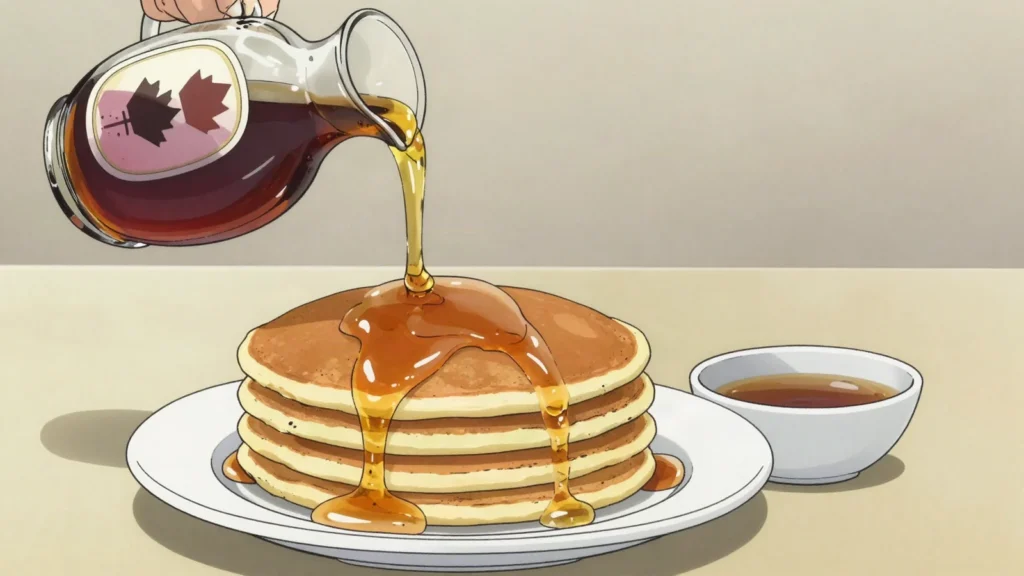
Maple syrup is a sauce & condiment from Canada: boiled maple sap poured over pancakes; Quebec makes most of the world’s supply. Indigenous peoples of the northeast tapped maples long before contact and taught French settlers; Quebec now produces most of the world’s supply.
How long does Maple syrup take to make?
Maple syrup takes 1 hr for tapping of preparation and 8 to 12 hr boiling of cooking. The recipe makes about 1 litre of syrup. It is rated hard to make.
What can I substitute in Maple syrup?
Yes, within limits. No maples: this cannot be substituted, only bought. If a recipe calls for maple syrup, avoid ‘pancake syrup’, which is corn syrup with flavouring and behaves quite differently in baking. Birch sap can be boiled the same way, but it needs about 100 litres per litre of syrup and tastes savoury and molasses-like rather than sweet.
What is the most important thing to get right in Maple syrup?
Boil hard in a wide shallow pan, adding fresh sap continuously to keep the level constant rather than boiling batch by batch. Surface area, not depth, is what drives evaporation.