
Ingredients
The fish
- 1skipjack tuna (katsuo) of 2–3 kg, gutted, headed and filleted into 4 loins (fushi)
- clean seawater or 3 percent brine for rinsing
Smoke and mould
- oak, ubame oak or cherry wood, split and dry, for 10–15 smoking days
- Aspergillus glaucus spores (katsuobushi kabi), as a starter dusting
- sun and open air for the drying cycles
To use: ichiban dashi
- 1 litresoft water
- 20 gkombu
- 30 gfreshly shaved katsuobushi
Directions
- Fillet the skipjack into four loins, keeping them intact, and rinse in cold brine. Larger fish are cut into four fushi, small ones into two.
- Simmer the loins in a bath held at 80–95°C (175–205°F) for 60–90 minutes, never boiling, until cooked through. This step, nijuku, sets the protein and stops spoilage.
- Cool, then pick out every bone and skin fragment with tweezers, patching any torn surface with a paste of mashed fish flesh so the loin dries evenly.
- Smoke over smouldering hardwood at around 80°C (175°F) for 5–6 hours a day, resting the loins overnight so moisture migrates back to the surface. Repeat this cycle for 10–15 days until the loins are hard, black and lacquered. This stage is arabushi.
- Scrape or sand off the tar and charred surface with a knife, revealing a dense red-brown block.
- Dust with Aspergillus glaucus and hold in a warm humid box for about 2 weeks until a green-blue bloom covers the block. The mould pulls out remaining moisture and digests fat, which is why the finished dashi is clear and not oily.
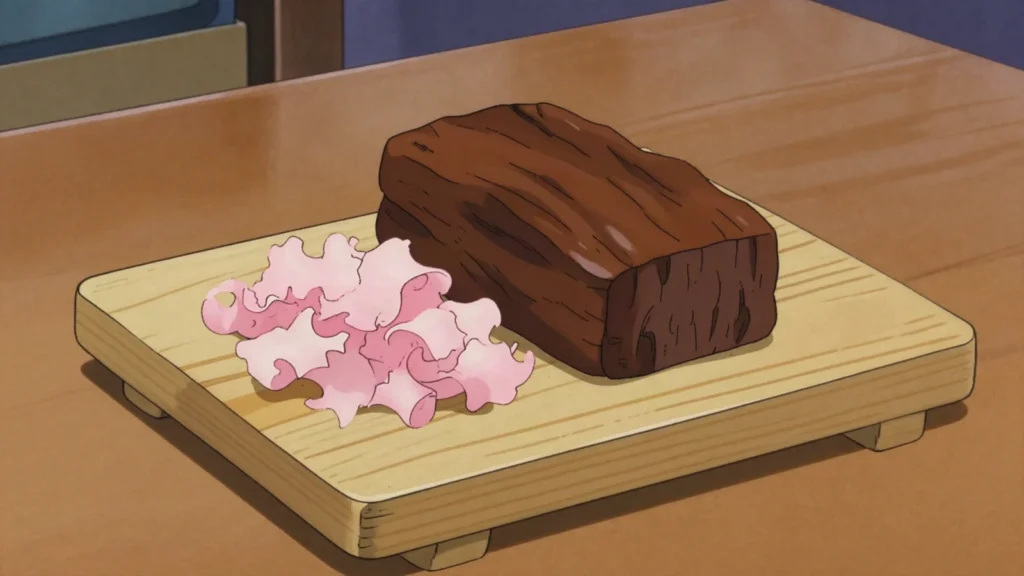
- Brush off the mould, sun-dry for a day, and repeat the mould-and-sun cycle at least 4 times over 4–6 months. The block loses about 80 percent of its original weight and becomes the hardest food in the world, ringing like wood when tapped. This is karebushi, or honkarebushi after 6 rounds.
- Shave to order on a kezuriki, a plane set into a wooden box, taking wide translucent ribbons; a fine blade for delicate hanakatsuo, a coarse setting for broth.
- For ichiban dashi, soak the kombu in cold water 30 minutes, heat slowly to 60–65°C (140–150°F) and hold 1 hour, or bring to just below the boil and lift the kombu out. Add the shavings off the heat, steep 1–2 minutes, then strain through cloth without pressing. Pressing makes it bitter and cloudy.
Technique
- Katsuobushi is the single largest natural source of inosinate, which multiplies the glutamate in kombu. That synergy is the chemical foundation of Japanese cooking, described by Kikunae Ikeda in 1908.
- The mould stage is deliberate and controlled. Any fluffy white, black or pink growth is contamination, not katsuobushi kabi, and the block should be discarded.
- Whole karebushi blocks are hard enough to break a knife. Never try to cut one; only ever plane it.
- Pre-shaved packets go stale fast. Buy small bags, seal them and use within a month or two.
Substitutions
- Do not attempt the full mould cure without a temperature and humidity controlled box. Buy karebushi or good hanakatsuo shavings; even in Japan almost nobody makes it at home.
- For a vegetarian broth of similar depth use kombu with dried shiitake soaked overnight, which gives guanylate instead of inosinate.
Variations
- Arabushi, the smoked but unmoulded block, cheaper, smokier and used for strong noodle broths.
- Sababushi, urumebushi and other fushi made from mackerel or sardine, blended into soba shop dashi.
- Okaka, shavings dressed with soy and used as a rice ball filling, and the dancing shavings scattered over okonomiyaki.
History
The mould-ripening honkarebushi method was refined in Kishu in the seventeenth century; the blocks are among the world’s hardest foods.
Frequently asked questions
What is Katsuobushi?
Katsuobushi is a charcuterie & cured from Japan: skipjack tuna smoked, mould-fermented and dried rock-hard, shaved into dashi flakes. The mould-ripening honkarebushi method was refined in Kishu in the seventeenth century; the blocks are among the world’s hardest foods.
How long does Katsuobushi take to make?
Katsuobushi takes 2 hr of active work of preparation and 4 to 6 months of cooking. The recipe makes about 300 g of finished karebushi from 2 kg of raw fish. It is rated hard to make.
What can I substitute in Katsuobushi?
Yes, within limits. Do not attempt the full mould cure without a temperature and humidity controlled box. Buy karebushi or good hanakatsuo shavings; even in Japan almost nobody makes it at home. For a vegetarian broth of similar depth use kombu with dried shiitake soaked overnight, which gives guanylate instead of inosinate.
What is the most important thing to get right in Katsuobushi?
Simmer the loins in a bath held at 80–95°C (175–205°F) for 60–90 minutes, never boiling, until cooked through. This step, nijuku, sets the protein and stops spoilage.