The small, elongated, copper-skinned onion that grows in clusters — sweeter, finer and more delicate than an onion, the allium of French sauces, Southeast Asian pastes and every good vinaigrette.
Where it comes from
The shallot is a variety of the common onion that forms a cluster of small bulbs rather than one large one; its name comes from Ascalon, the Levantine port through which medieval Europe thought it had arrived. It became the onion of French cooking — the beurre blanc, the bordelaise, the mignonette for oysters, the vinaigrette — because it dissolves into a sauce without the harshness and sulphur of a big onion, and it is the onion of Thai, Vietnamese, Indonesian and Malaysian kitchens, pounded into pastes and fried crisp for scattering.
Asian shallots are smaller, rounder and pinker than the long French ones, and stronger; fried in slices until golden and crisp they are the topping of Thai salads, Indonesian nasi goreng and Vietnamese noodle soups. The banana shallot, or échalion, is a large, long shallot–onion cross that peels easily and stands in for several small ones.
Varieties
- French grey shallot (griselle) — Small, grey-skinned, firm, with the finest and most intense flavour. The connoisseur’s shallot; hard to find.
- Pink / Jersey shallot — Elongated, copper-pink skin, cluster of two or three bulbs; the standard French and British shallot.
- Banana shallot (échalion) — Large, long, easy to peel; a shallot–onion cross. The kitchen’s practical shallot.
- Thai / Asian red shallot — Small, round, purple-red, pungent. Pounded into curry pastes and fried crisp.
- Dutch yellow shallot — Round, yellow-brown, milder; common in northern Europe.
In the kitchen
Mince fine for a vinaigrette or a sauce and let it sit a few minutes in the vinegar or wine, which softens its bite; cook gently in butter until translucent for a sauce base, never browned unless that is the point. Sliced thin and fried slowly in plenty of oil until golden and crisp, then drained, they are the Southeast Asian garnish that keeps for weeks.
Shallots roast whole beautifully, turning sweet and jammy in their skins beside a joint. In a Thai paste they are pounded raw with garlic, galangal and chilli. A shallot where a recipe says onion is a refinement; an onion where it says shallot is a coarsening.
Choosing and keeping
Firm, dry, with tight papery skins and no sprouting or soft spots. They keep a month or more somewhere cool, dry and dark, not in the fridge. Sprouted shallots are still usable but sweeter and softer.
Peeling small shallots is tedious; a minute in boiling water loosens the skins. Banana shallots are the answer when many are needed.
Dishes with shallot
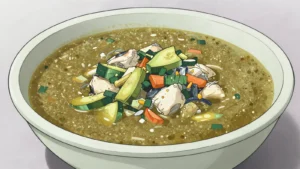 Samlor KorkoAncient 'stirring soup' of many vegetables, roasted rice and fish
 Nasi KatokPlain rice, fried chicken and sambal in paper; beloved cheap meal
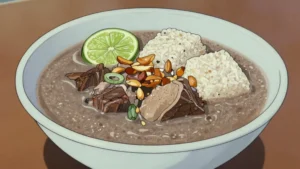 Coto MakassarBeef and offal soup thickened with ground peanuts and rice water, eaten with ketupat
 Filet américainSeasoned raw minced beef spread on bread or with fries.
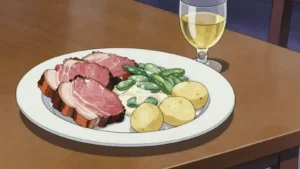 Judd mat GaardebounenSmoked pork collar with broad beans in cream sauce; national dish.
 Nasi PadangSteamed rice with a spread of Padang curries and sambals
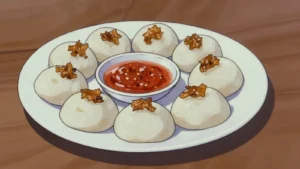 Chwee KuehSteamed rice cakes topped with salty preserved radish and chilli
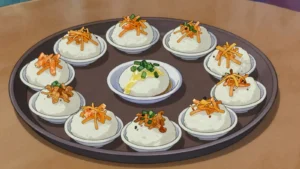 Banh BeoHue steamed rice discs topped with dried shrimp and spring onion oil
Shallot is tagged on 157 dishes from 32 countries in the atlas. These notes are written from general knowledge and carry no per-fact citation — see About.