
Ingredients
Salsa
- 4ripe tomatoes
- 2locoto or rocoto chillies, deseeded
- 1large handful quirquiña
- 1small handful huacataya, optional
- 1spring onion, optional
- 1 tspsalt
Equipment
- a batán, the flat grinding stone, or a heavy mortar
To serve
- on the table, with everything
Directions
- Roast or scald the tomatoes briefly and slip the skins off, or leave them raw for a sharper version.
- Deseed the locoto unless you want it genuinely fierce; the heat is concentrated in the seeds and the pale ribs.
- Locoto, known as rocoto in Peru, is a thick-walled chilli with black seeds and a distinctive fruity heat, and it is what makes llajwa taste Bolivian rather than generically hot.
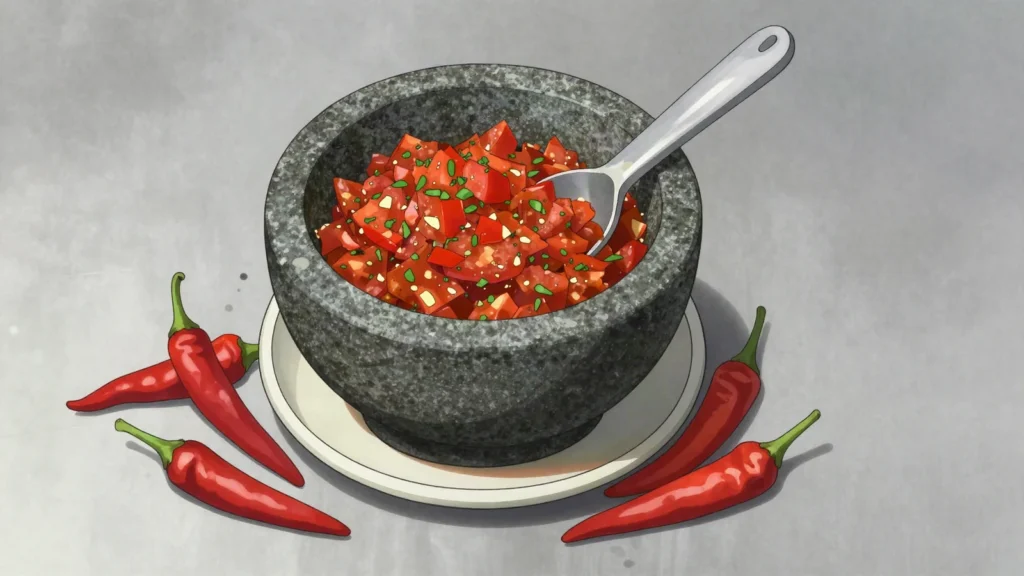
- Now the grinding, which is the whole method. Put the chilli and salt on the batán first and crush them with the rocking stone.
- The batán is a flat stone with a curved rocking stone worked over it, and it crushes and smears rather than chopping. A blender purées, which gives a thin, foamy, pale salsa instead of a thick rough one.
- Add the tomatoes a piece at a time and grind them into the chilli.
- Work them in gradually. Everything at once slides around on the stone and nothing breaks down.
- Add the quirquiña last and grind it through.
- Quirquiña, Bolivian coriander, is the defining herb and it tastes of nothing else: sharper and more resinous than coriander, with a hint of rocket.
- Huacataya, Andean black mint, is the second herb and it is used in smaller quantity because it dominates quickly.
- Keep grinding until it is thick, coarse and uniformly red-orange, with visible flecks of green.
- It should hold its shape on a spoon rather than run, and the texture is what distinguishes a hand-ground llajwa immediately.
- Taste for salt and heat, and add more locoto only a little at a time, because it builds.
- Make it fresh and make it on the day. Llajwa loses its brightness within hours and Bolivian households grind it at each meal.
- Serve it in a small bowl on the table, alongside almost anything: salteñas, silpancho, boiled potatoes, grilled meat, soup.
- It sits on the table the way salt does, and a Bolivian meal without it is considered incomplete.
Technique
- The batán is a genuine household object rather than an affectation, and many families have an inherited one.
- Quirquiña is hard to find outside the Andes; coriander with a little rocket is the nearest approximation.
- There is a cooked version, but the raw one is the everyday standard.
Substitutions
- Habanero or scotch bonnet in place of locoto, used sparingly.
- Coriander with a few rocket leaves, in place of quirquiña.
Variations
- Llajwa de maní, with peanuts ground in.
- With the tomatoes roasted for a deeper, sweeter salsa.
- Without huacataya, which many households leave out.
History
Table sauce of locoto chilli and quirquina herb ground on a stone batan, present at nearly every Bolivian meal.
Frequently asked questions
What is Llajwa?
Llajwa is a sauce & condiment from Bolivia: fiery tomato-locoto salsa ground on stone, on every table. Table sauce of locoto chilli and quirquina herb ground on a stone batan, present at nearly every Bolivian meal.
How long does Llajwa take to make?
Llajwa takes 20 min of preparation and no cooking at all. The recipe makes about 300 ml. It is rated easy to make.
What can I substitute in Llajwa?
Yes, within limits. Habanero or scotch bonnet in place of locoto, used sparingly. Coriander with a few rocket leaves, in place of quirquiña.
What is the most important thing to get right in Llajwa?
Locoto, known as rocoto in Peru, is a thick-walled chilli with black seeds and a distinctive fruity heat, and it is what makes llajwa taste Bolivian rather than generically hot.