
Ingredients
What to buy
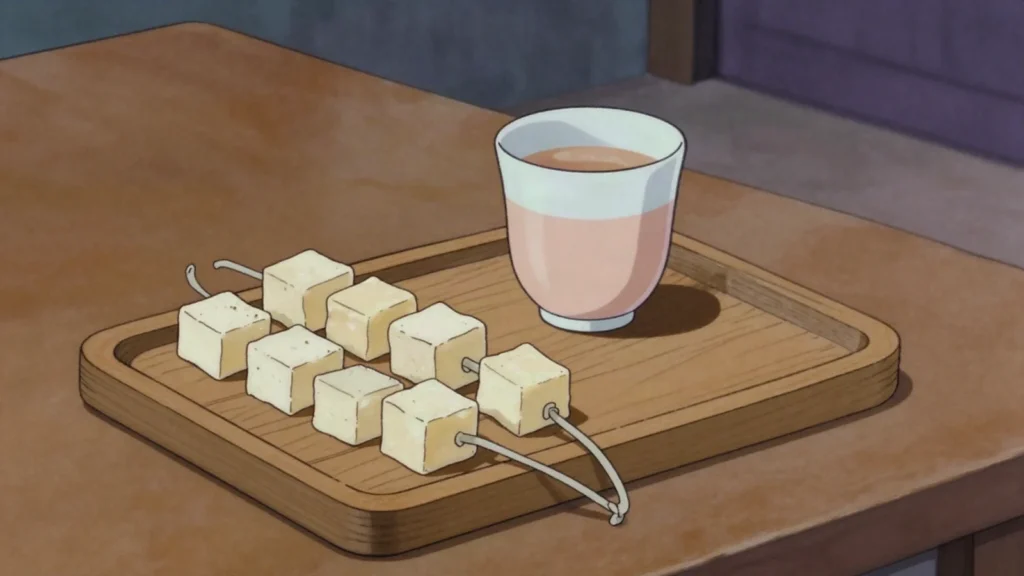
- chugo, dried cheese cubes on a string
- also sold as chhurpi, hard chhurpi or durkha
- from a Himalayan, Nepali or Tibetan grocer
- or online
- see the note on dog chews
- and the note on why no method is given
To eat it
- one cube at a time
- very slowly, see the safety note
- with suja, butter tea
- or with ngaja, sweet milk tea
To soften it, if you prefer
- hot butter tea
- or hot water
- a few minutes’ soak
Directions
- Warm and humid grows mould instead. Eating it in particular needs saying.
- Put a cube in your cheek.
- Let saliva and warmth soften it. Give it twenty or thirty minutes before you chew at all.
- Take one cube. Hold it in your cheek.
- Wait. It softens gradually over half an hour.
- Soak it in hot butter tea or hot water first. A few minutes softens the outside considerably.
- Keep it dry and airy rather than sealed damp.
Technique
- Never bite it. Chugo is harder than any food most people have met and does not yield to a bite — biting down can crack a tooth or break a filling or crown. Put a cube in your cheek and let saliva and warmth soften it for twenty or thirty minutes before you chew at all. That slowness is the point of the food rather than an inconvenience: it was made to be chewed on a long walk.
- It is not suitable for young children. A hard cube is a choking hazard, and so is a piece that breaks off.
- Anyone with crowns, veneers, implants or braces should soften it in hot tea first.
- Hard Himalayan cheese is widely sold in the West as a dog chew — the same product under a different label, often cheaper and easier to find. Buy a version sold for human consumption where you can, since pet products are not made under food-grade rules and labelling and traceability differ. The atlas records this because people find it genuinely confusing in a shop.
- Chhurpi comes in two kinds and they are not interchangeable. Hard chhurpi is this: dried, smoked, rock solid, chewed. Soft chhurpi is a fresh crumbly curd cooked into curries and soups. A recipe calling for chhurpi usually means the soft kind, and buying the hard kind for it will not work.
- Soaking it in hot butter tea or hot water for a few minutes softens the outside considerably. Purists chew it dry; soaking is a reasonable thing to do, and the atlas records both without judging.
- The atlas gives no making method: yak milk is not obtainable outside the Himalaya and is far higher in fat and solids than cow’s milk, and the drying takes weeks in cold dry mountain air. Slow ambient drying of a dairy product needs that climate — warm and humid grows mould instead. The climate is the equipment.
- The butter is the valuable product and the cheese is made from the buttermilk left after churning. That is the economy of it.
- Dried this way it keeps a year or more without refrigeration, light and unspoiling — food for a journey. Keep it dry and airy rather than sealed damp, since damp softens it and lets mould start.
- Judge it by uniform hardness, pale to amber colour and a faint milk and smoke smell. Any mould, softness, dampness or rancid smell means leave it — rancid fat smells of old paint or crayon.
- The flavour is subtle rather than strong, sweetening as it softens. The experience is the slowness.
- Suja, the churned butter tea it is eaten with, is savoury rather than sweet and surprises people expecting tea. Hot salty fat softens the cheese and suits it.
- Aged and drained cheeses are low in lactose, but how low depends on the make — anyone who needs to know should ask rather than assume.
Substitutions
- Hard chhurpi from Nepal, Sikkim or Darjeeling is the same product.
- Himalayan dog chews are the same cheese sold for pets.
- Soft chhurpi is the fresh curd used in cooking, and is a different thing.
- Aged hard cheeses give the flavour but never the texture.
- Dried curd snacks from Central Asia, such as qurut, are the nearest relatives.
- Suja or any butter tea is what it is eaten with.
Variations
- Soft chhurpi is cooked with ferns, mushrooms and chillies.
- Smoked and unsmoked versions are both made.
- Qurut in Central Asia is the dried salted curd equivalent.
- Chhurpi soup and chhurpi pickle use the soft kind.
- Cow’s milk chhurpi is made where yaks are not kept.
- Datshi, the fresh Bhutanese cheese, is what goes into ema datshi.
History
Made by highland yak herders in Bumthang and Haa as a way to store milk for winter travel; softened only by long chewing.
Frequently asked questions
What is Chugo?
Chugo is a cheese & dairy from Bhutan: yak cheese cubes dried rock-hard and strung on thread, chewed slowly for hours. Made by highland yak herders in Bumthang and Haa as a way to store milk for winter travel; softened only by long chewing.
How long does Chugo take to make?
Chugo takes 5 minutes of preparation and none of cooking. The recipe makes buy a string; one cube lasts an hour. It is rated easy to make.
What can I substitute in Chugo?
Yes, within limits. Hard chhurpi from Nepal, Sikkim or Darjeeling is the same product. Himalayan dog chews are the same cheese sold for pets. Soft chhurpi is the fresh curd used in cooking, and is a different thing. Aged hard cheeses give the flavour but never the texture. Dried curd snacks from Central Asia, such as qurut, are the nearest relatives. Suja or any butter tea is what it is eaten with.
What is the most important thing to get right in Chugo?
Never bite it. Chugo is harder than any food most people have met and does not yield to a bite — biting down can crack a tooth or break a filling or crown. Put a cube in your cheek and let saliva and warmth soften it for twenty or thirty minutes before you chew at all. That slowness is the point of the food rather than an inconvenience: it was made to be chewed on a long walk.