
Ingredients
Curing
- 2pairs grey mullet roe sacs, about 400 g total, membranes completely intact
- 1.5 kgcoarse sea salt
- 2wooden boards and a 2 kg weight, for pressing
Sealing and serving
- 200 gfood-grade beeswax, melted
- 1lemon, in wedges
- good olive oil
- baladi bread or plain crackers
- thinly sliced raw onion
Directions
- Rinse them gently in cold water, taking care not to nick or tear the membrane, since a punctured sac will absorb salt unevenly and spoil at the tear. Massage each sac very gently under running water to work out any blood held in the veins, then pat completely dry.
- Cure 3 days for small sacs, up to 6 for large, turning once a day and replacing any salt that has turned wet and slushy. Test by feel: the sacs should be firm all the way through with no soft spot in the middle, like a well-set cheese.
- Rinse off all the surface salt in cold water, pat dry, and press between two boards under a 2 kg weight in the fridge for 12 hours, which flattens the sac and drives out remaining moisture.
- Hang or lay the sacs on a rack to air-dry in a cool, airy, shaded place at 12–16°C (55–60°F) for 2 to 4 weeks, turning daily. Traditionally this happens in the shade of a sea breeze, never in direct sun, which would cook the outside and trap moisture inside.
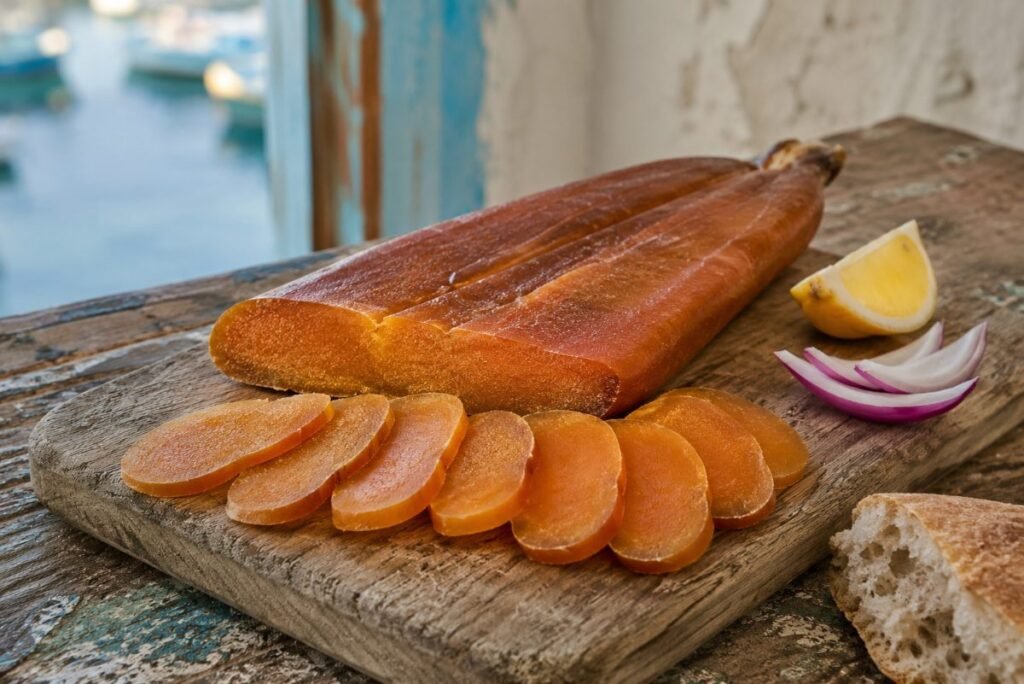
- Dip each dried sac in melted beeswax to seal it. To eat, peel back the wax and the membrane, slice into 2 mm translucent orange slivers with a wet knife, and serve with lemon, olive oil, raw onion and bread.
Technique
- Batarekh is the Egyptian ancestor of Italian bottarga and Greek avgotaraho, and the technique is documented on Old Kingdom tomb walls. The wax seal is the Egyptian signature; the Mediterranean versions are usually left bare or vacuum-packed.
- This is a salt cure, and the safety of it rests on getting the salt right through the sac and then drying to a low water activity. If a sac develops a soft spot, a sour or ammoniac smell, or any sliminess under the membrane, throw it away.
- Batarekh is not fesikh. Fesikh is salt-fermented whole mullet eaten at Sham el-Nessim, and it has caused fatal botulism outbreaks; the two are often confused because both start with the same fish.
Substitutions
- No grey mullet roe: tuna roe cures the same way and is the standard substitute in Sicily, though it is coarser and more assertive.
- No beeswax: vacuum-seal the dried roe instead, or wrap it tightly in cling film. The wax is for preservation, not flavour.
Variations
- Sliced onto buttered toast with lemon, the Alexandrian mezze serve.
- Grated over pasta or over a plate of white beans, a Mediterranean crossover that Egyptians will tell you is not the point.
History
Egyptian tomb reliefs show mullet roe being salted and dried; the coastal lagoons still supply it, and it is a delicacy at Sham el-Nessim.
Frequently asked questions
What is Batarekh?
Batarekh is a charcuterie & cured from Egypt: salted pressed grey mullet roe sealed in wax, sliced thin with lemon. Egyptian tomb reliefs show mullet roe being salted and dried; the coastal lagoons still supply it, and it is a delicacy at Sham el-Nessim.
How long does Batarekh take to make?
Batarekh takes 1 hr, spread over 3 weeks of preparation and 3–4 weeks curing and drying of cooking. The recipe makes about 200 g cured roe (serves 8–10). It is rated hard to make.
What can I substitute in Batarekh?
Yes, within limits. No grey mullet roe: tuna roe cures the same way and is the standard substitute in Sicily, though it is coarser and more assertive. No beeswax: vacuum-seal the dried roe instead, or wrap it tightly in cling film. The wax is for preservation, not flavour.
What is the most important thing to get right in Batarekh?
Hang or lay the sacs on a rack to air-dry in a cool, airy, shaded place at 12–16°C (55–60°F) for 2 to 4 weeks, turning daily. Traditionally this happens in the shade of a sea breeze, never in direct sun, which would cook the outside and trap moisture inside.