The fruit of the Indian subcontinent — sweet, fragrant, silky when ripe — eaten in more forms than almost any fruit: ripe, green and sour, dried, pickled, powdered into amchur, puréed into lassi and cooked into chutney.
Where it comes from
The mango has been cultivated in India for over four thousand years and is woven into its culture — the Buddha rested in a mango grove, the paisley pattern is a mango, and Indian cuisine uses the fruit at every stage of ripeness. Buddhist monks carried it to Southeast Asia, the Persians to East Africa, the Portuguese to Brazil and West Africa and, from there, to the Caribbean and Mexico. India still grows the most by far, with hundreds of named varieties, but Mexico, Thailand, Pakistan and Brazil export more.
Green and ripe mango are two ingredients. The unripe fruit is hard, crisp and very sour and is eaten with salt and chilli as a snack across Asia and Latin America, shredded into Thai salads, pickled in oil and spices as the Indian aam ka achar, and dried and ground into amchur, a souring powder. The ripe fruit is eaten fresh, in lassi and kulfi, in sticky rice with coconut milk in Thailand, and cooked into the sweet-hot chutneys that the British took home.
Varieties
- Alphonso (hapus) — The most prized Indian mango: small, golden, saffron-fleshed, intensely sweet and perfumed, with a short spring season.
- Kesar — Gujarati; deep orange, sweet, aromatic; the mango of pulp and lassi.
- Ataúlfo / honey (champagne) mango — Small, kidney-shaped, yellow, with buttery fibreless flesh; Mexican, and the best supermarket mango outside India.
- Tommy Atkins — Large, red-green, firm, fibrous, mild; the most shipped mango and the least flavoured.
- Kent and Keitt — Large, green-skinned, sweet and juicy with little fibre; late-season Florida and Mexican varieties.
- Nam Dok Mai — The Thai eating mango: long, yellow, very sweet and fragrant; the mango of khao niao mamuang.
In the kitchen
To cut: stand the fruit on end and slice down either side of the flat stone, then score the flesh in a grid and push the skin inside out so the cubes stand up, or spoon it out. Ripe mango is eaten as it is, blended into lassi with yoghurt, or set on coconut sticky rice. It does not want cooking beyond a gentle warming; its perfume goes.
Green mango is grated or julienned into Thai and Vietnamese salads with lime, fish sauce, chilli and peanuts, or into Indian chutneys and pickles. Amchur sours a chaat masala or a curry where lemon would add liquid. Mango chutney — ripe or green fruit cooked with sugar, vinegar, ginger and spice — keeps for a year.
Choosing and keeping
Judge ripeness by feel and smell, not colour — a ripe mango yields slightly and smells sweet at the stem; some varieties stay green when ripe. Ripen hard fruit at room temperature in a paper bag, then refrigerate for a few days at most.
Tinned Alphonso or Kesar pulp from Indian grocers is a very good product for lassi, kulfi and sauces. Dried mango keeps for months. Frozen mango chunks are fine for blending.
Dishes with mango
 DoublesTwo barra flatbreads with curried chickpeas and chutneys
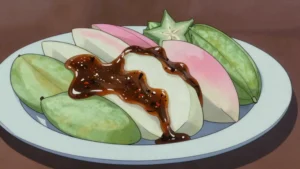 RujakUnripe fruit tossed in a dressing of palm sugar, tamarind, chilli and shrimp paste
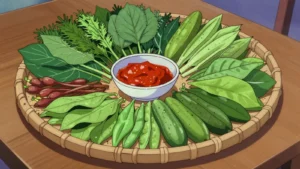 UlamPlatter of raw jungle leaves and shoots eaten with sambal and rice
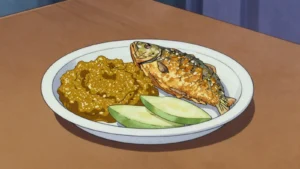 KasundiSharp fermented mustard sauce, eaten with fried fish and raw green mango
 THBThree Horses Beer, the pale lager poured in every Malagasy bar
 BhelpuriPuffed rice tossed with onion, tamarind and coriander chutney in a paper cone
 KotaQuarter loaf hollowed and packed with chips, polony, cheese and atchar
 Boller i karryPork meatballs in a mild curry sauce over rice
Mango is tagged on 57 dishes from 41 countries in the atlas. These notes are written from general knowledge and carry no per-fact citation — see About.