
Ingredients
The corn
- 6 earsfresh maize
- husks removed
- silk pulled off
- fresh rather than old
The fire
- charcoal
- a wire rack
- or a grill over coals
Sometimes used
- salt water, to brush
- a little oil
- a piece of lime
To serve
- hot from the coals
- in the hand
- at a roadside stand
Directions
- Turn it constantly to control that. Charcoal fires burn genuinely very hot. Keep them well away from anything flammable. Keep water or sand close to hand. Never leave a lit fire unattended.
- Pull all the husks off each cob. Peel them back and snap them off. Rub the cob to remove the last silk. Check between the rows of kernels.
- Trim the stalk end if it is long. Leave a few centimetres of it. Wait until it glows under grey ash. That is what the method needs.
- Set the rack close above the coals. Too far and it dries without charring. Lay the cobs on the wire rack. Turn them constantly from the start.
- Turn them every thirty seconds or so. Cooking them takes about fifteen minutes. Stand slightly back as they pop. Judging them takes a careful look.
- Press a kernel with a fingernail. It should be soft rather than hard. Brush them with salt water as they roast. Salt water seasons them as they cook. It also helps the surface char. Brush it on partway through cooking. It is not always done that way though.
- Serve them straight from the fire. The kernels go chewy and quite dry. Hold them all by the stalk end. Let them cool a moment before biting. Rub a cut lime over the hot cob. They are eaten hot from the hand.
Technique
- Charcoal produces carbon monoxide, which is odourless and genuinely lethal — people die from this every year when charcoal is brought indoors or burnt in tents and garages. Burn it outdoors only, never in an enclosed space. Keep the fire away from anything flammable, keep water or sand to hand and never leave it unattended.
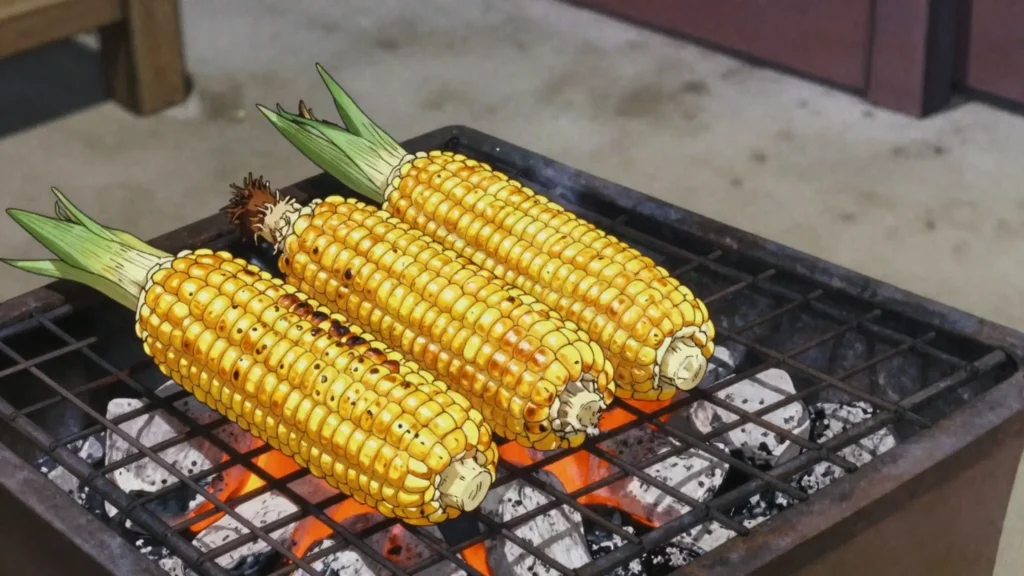
- Wait for embers glowing under grey ash rather than flames, which burn the corn black instantly, and set the rack about ten centimetres above them since corn wants genuinely direct heat — too far and it dries out without charring.
- Turn the cobs every thirty seconds or so from the start, which is the whole technique: that gives even charring where leaving them still burns one side. Aim for charred black patches on deep golden kernels — some blackening is wanted, but uniformly black tastes only of ash.
Substitutions
- Sweetcorn is the available substitute for the starchier green field maize used in West Africa: it is sweeter, more tender and cooks faster, so it is not the same but works.
- Brushing with salt water partway through seasons the cobs and helps the surface char, though it is not always done.
Variations
- Pull off every strand of silk, checking down between the rows of kernels where it hides, since it burns instantly on the coals and tastes unpleasant; leave a few centimetres of stalk as a handle for turning and holding.
- Kernels pop and crackle as moisture turns to steam, which is entirely normal — stand slightly back. Test one from the middle rows by pressing with a fingernail: it should be soft rather than hard.
- The atlas also carries Eswatini roasted mealies, essentially the same practice in another country. Roadside roasted maize is common right across Africa and beyond, and each entry records its own local setting rather than the two being merged or pretended different.
History
Sold at Monrovia junctions during the harvest months, roasted to order on wire racks over charcoal.
Frequently asked questions
What is Roasted corn?
Roasted corn is a street food from Liberia: fresh maize cobs peeled and roasted over coals at the roadside. Sold at Monrovia junctions during the harvest months, roasted to order on wire racks over charcoal.
How long does Roasted corn take to make?
Roasted corn takes 10 minutes of preparation and 20 minutes of cooking. The recipe makes serves 6. It is rated easy to make.
What can I substitute in Roasted corn?
Yes, within limits. Sweetcorn is the available substitute for the starchier green field maize used in West Africa: it is sweeter, more tender and cooks faster, so it is not the same but works. Brushing with salt water partway through seasons the cobs and helps the surface char, though it is not always done.
What is the most important thing to get right in Roasted corn?
Turn it constantly to control that. Charcoal fires burn genuinely very hot. Keep them well away from anything flammable. Keep water or sand close to hand. Never leave a lit fire unattended.